The DHIS2 Annual Conference takes place from 15-18 June 2026! Learn more


The DHIS2 Annual Conference takes place from 15-18 June 2026! Learn more
HISP UiO exceeded our goals in the two-year “proof of concept” phase of our Wellcome-funded work, developing groundbreaking open-source tools for climate-health data integration and AI-powered predictive modeling and leading catalytic action research in 10 countries.
The first phase of the DHIS2 Climate & Health project, funded by the Wellcome Trust, concluded at the end of February 2026. The goal of this initial two years was for HISP UiO and the HISP network to support effective health response to climate-related health risks by making climate-health data actionable in country-owned health information systems in low- and middle-income countries (LMICs) using open-source tools. The initial target–established in dialogue with Wellcome–was to demonstrate a “proof of concept” by piloting climate and health use cases in 3 exemplar countries with the aim of catalyzing further progress in this field.
In March 2026, the HISP team presented a summary of the results of the project to Wellcome and current and potential partners. Climate and health experts from Wellcome praised HISP’s exciting work overall, and in particular the excellent tools that were developed during this phase and our success in co-developing use cases in 10 countries and launching work in 6 more with support from the Global Fund.
“This has been great. It’s really good to see how much progress has happened, and to start seeing a glimpse of what’s about to happen in the near future.”
— Dr. Felipe Colón, Technology Lead, Data for Science and Health, Wellcome Trust
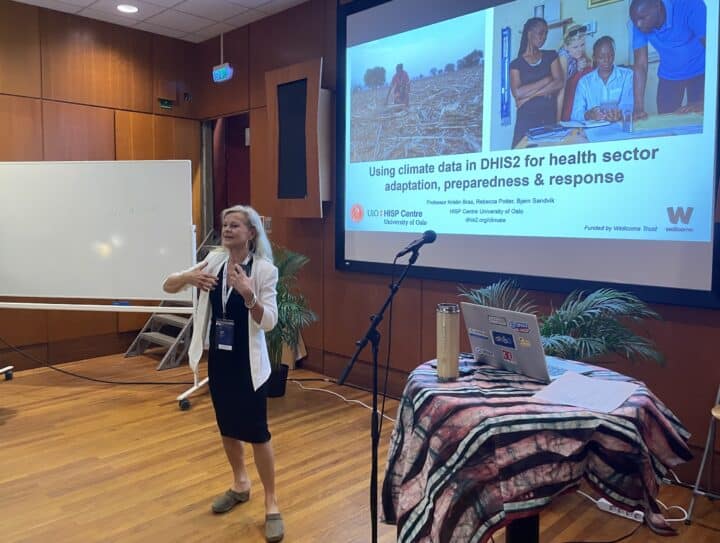
Two significant barriers were identified at the start of the project. First was the persistent challenge of integrating and harmonizing climate and health data, compounded by a general lack of digitized climate and weather data in LMICs. The second was the difficulty in operationalizing the use of predictive models for climate-sensitive diseases to forecast future trends and outbreaks, given that the majority of software development in this area was primarily research driven, narrowly focused on specific geographies and diseases and developed in a way that did not facilitate actionable routine early warning systems. To address these challenges, HISP prioritized work in two corresponding areas: integration and harmonization of climate data into DHIS2 health systems and development of integrated analytic and modeling tools to help operationalize planning, early warning, and response.
The new digital tools we developed during this project phase are:
Centering our approach to this project around the open-source DHIS2 platform made it possible to build on the footprint of country-owned DHIS2 health information systems in 75+ countries, leverage existing capacities and infrastructure. This work followed the time-tested HISP approach, in which locally-led action research in LMICs drives the iterative development of open-source, globally available platforms and resources. Having local HISP groups and researchers work hand-in-hand with Ministries of Health, national meteorological agencies, and other local stakeholders helped ensure that the solutions and partnerships developed through the project were sustainable, country-led, and country-owned.
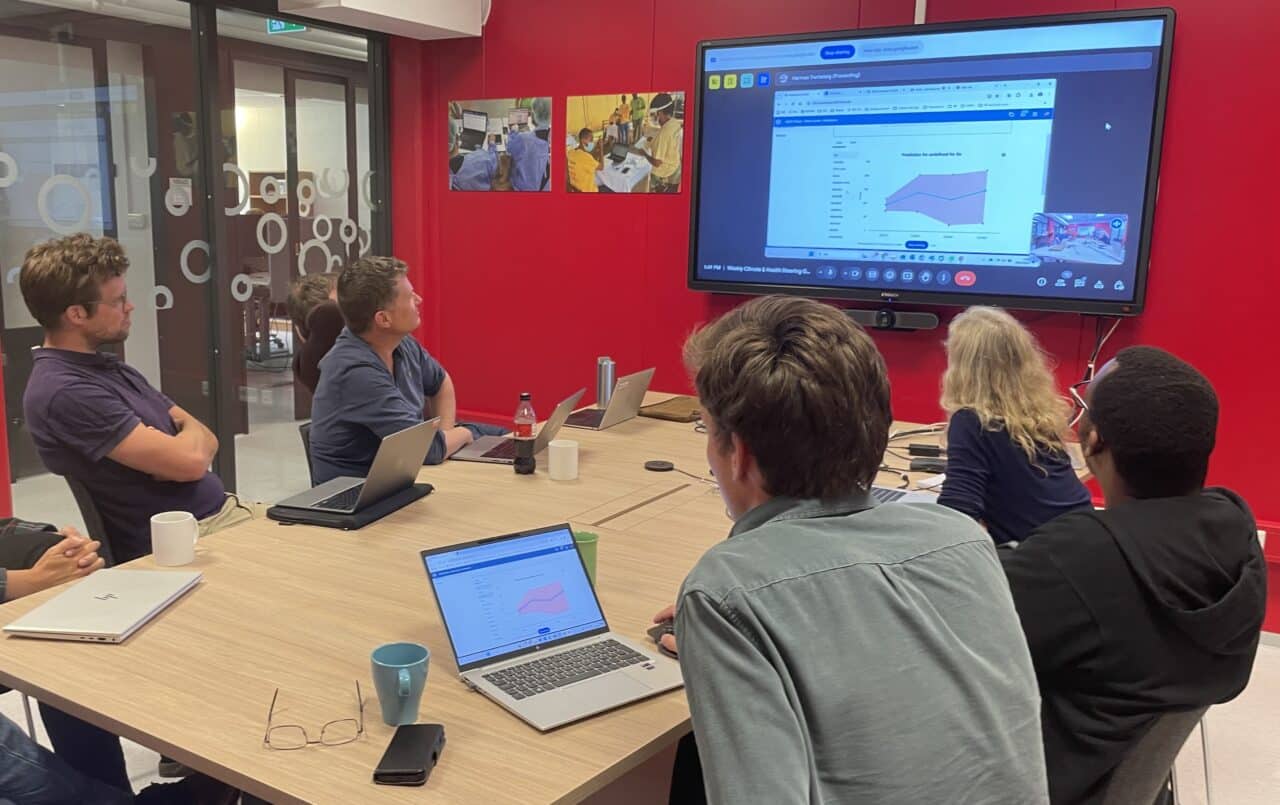
In coordinating this project, HISP UiO has emphasized inter-country collaboration, knowledge exchange, and capacity building. Members of the project teams from each of the 10 pilot countries have had virtual meetings every week to share experiences and questions with each other and the HISP UiO team. This has helped us to quickly identify and respond to challenges as they arise–leading to iterative releases of Chap and the Climate App to address reported issues and emerging demands–and allowed countries to learn from each other. This has accelerated the spread of use cases, such as malaria stratification and risk-mapping, as successful approaches from one pilot country could be quickly adapted and deployed in another.
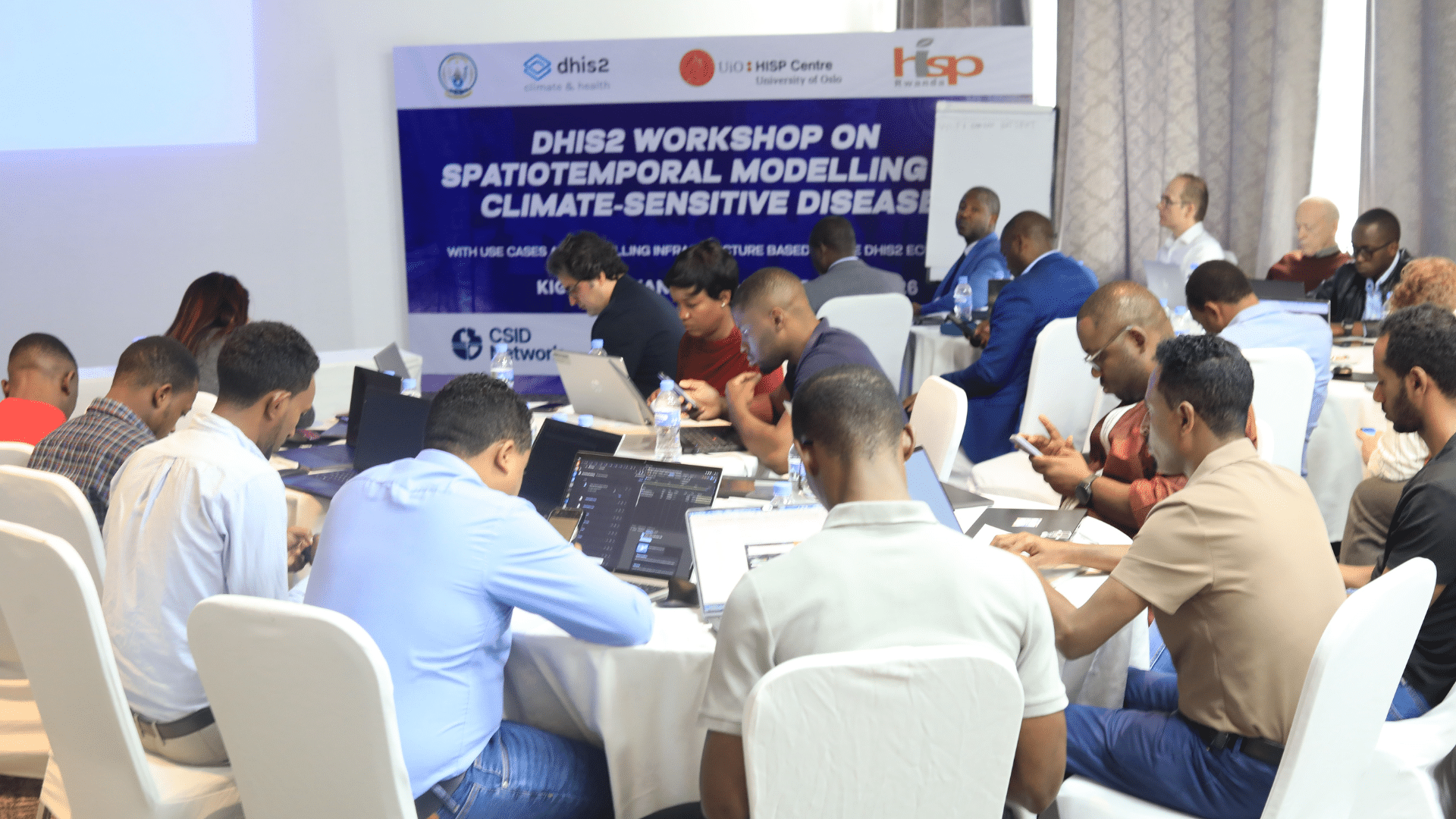
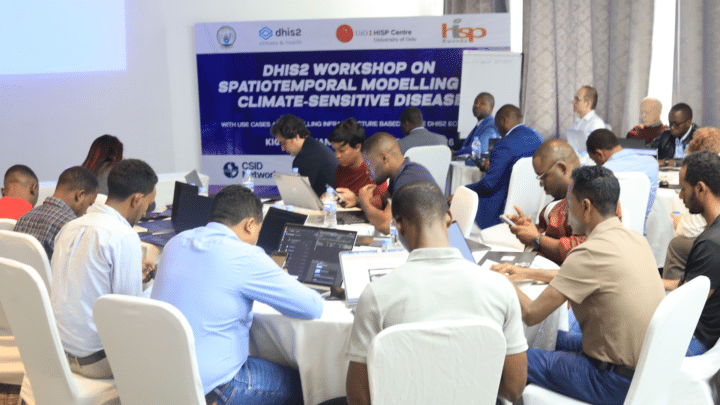
In-person gatherings have also played a key role in advancing this work. In 2025, representatives from all country teams and partners gathered in Oslo the week before the DHIS2 Annual Conference to present their work so far and discuss the way forward. In October 2025, the teams joined technical and domain experts for a weeklong workshop in Addis Ababa, Ethiopia on climate data integration in DHIS2. And in early 2026, a public webinar series on spatiotemporal modeling of climate-sensitive diseases culminated in a hands-on modeling workshop in Kigali, Rwanda, where 68 participants representing 16 LMICs spent an intensive week building skills in using the Chap Modeling Platform and refining their use cases in partnership with health programs, researchers, and subject matter experts.
“Participants in Kigali were working on their own data, their own DHIS2 instances, using local models and global models. We believe that this supports digital sovereignty, building local ownership of data, systems, infrastructure, and models. We really believe that having ownership of the models and being able to customize and tailor and train the models is very powerful.”
—Professor Kristin Braa, Director of the HISP Centre
The results of this “proof of concept” phase greatly exceeded our initial goals. 10 countries developed climate and health use cases that leverage their national DHIS2 systems and respond to local needs and priorities identified in national health adaptation plans (H-NAPs).
These include:
These use cases draw on several innovative tools developed by HISP UiO. The DHIS2 Climate App has been a huge success, downloaded and installed into more than 9,000 DHIS2 instances since it was released in April 2024. The Chap Modeling Platform has emerged as a groundbreaking tool that enables researchers worldwide to share their models across borders and contexts and lets health stakeholders easily connect these models to their own data sources. The DHIS2 Climate Tools provides a powerful, flexible, and fully open-source toolkit for integrating all kinds of geospatial data into DHIS2.
The potential of these tools has led to DHIS2 being recognized as a leading Global Good for Climate & Health and to their rapid adoption by countries and organizations worldwide.
While the first phase went beyond expectation, there is still much work remaining to tap the full potential of using such decision support tools to inform actions that can markedly reduce the burden of climate-sensitive disease. HISP’s work on DHIS2 for Climate & Health continues following the conclusion of this first phase of our Wellcome-funded work. We have secured additional funding partners for our climate health portfolio, including strategic and operational support from Norad and an expansion into 7 additional countries through the Global Fund’s catalytic Climate x Health initiative.
HISP is also working with Africa CDC–which HISP UiO has an ongoing partnership with under Africa CDC’s memorandum of understanding with the Kingdom of Norway–to support their ambitious continental climate change and health strategy. We also have ongoing collaborations with research groups and other partner organizations at the national, regional and global level, and participate in climate and health initiatives led by the WHO, including through our membership in the Alliance for Transformative Action on Climate and Health (ATACH) and our ongoing work as a WHO Collaborating Centre. To support further adoption and capacity building, HISP UiO is arranging the first-ever DHIS2 Climate & Health Academy, taking place in Oslo in June 2026.
Organizations that are interested in contributing to this work or collaborating with us are invited to contact HISP UiO at climate@dhis2.org.
Learn more: