The DHIS2 Annual Conference takes place from 15-18 June 2026! Learn more

DHIS2 for Agriculture
Discover how DHIS2 can support agricultural planning, sustainable food systems, animal health, and climate resilience through integrated data, geospatial analytics, and real-time monitoring—using flexible digital tools adapted to national and subnational agricultural contexts.
Jump to a section on this page
Overview: Strengthening agricultural systems with DHIS2
Agricultural systems depend on timely, integrated data to respond to climate variability, support farmers, improve productivity, and promote sustainable land use. Digital platforms like DHIS2 provide a powerful foundation for planning, monitoring, and evaluating agricultural programs, while enabling the integration of climate, environmental, geospatial, and field-level data.
As a scalable and configurable platform, DHIS2 can serve as the backbone for national agriculture information systems, supporting use cases such as climate-smart agriculture, food security monitoring, animal health, geospatial productivity analysis, soil and land management, and agricultural sustainability initiatives like carbon farming. DHIS2 enables countries and organizations to combine aggregate indicators, geospatial data, and event-based field records in a single, interoperable system—supporting decision-making from farm level to national policy. It can also support cross-sector data sharing to facilitate One Health approaches to protect our ecosystems and address health challenges in an integrated way.
Across diverse contexts, DHIS2 is being adapted beyond health to support agricultural resilience, sustainability, and innovation, often in collaboration with ministries of agriculture, climate agencies, research institutions, and private-sector partners.
DHIS2 Features for Agriculture
The DHIS2 platform includes built-in tools that support the full range of agricultural data needs—from spatial planning and field-level data collection to advanced analytics and cross-sector integration. These features enable ministries of agriculture, climate agencies, and partners to manage agricultural information efficiently, strengthen decision-making, and respond to emerging risks with timely, data-driven insights.
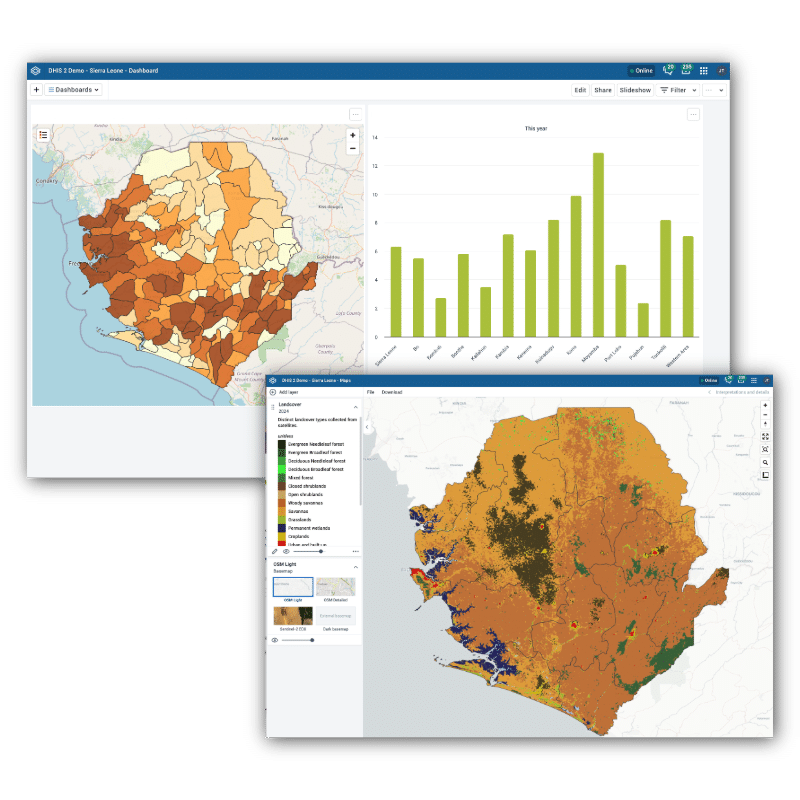
Geospatial data for analysis & planning
- Create interactive maps to visualize agricultural indicators, land use, productivity, and risk across administrative levels.
- Overlay satellite-derived layers such as vegetation indices, flood exposure, and land cover directly in DHIS2 maps.
- Harmonize external datasets (climate, soil, remote sensing) with national administrative units for consistent analysis.
- Map farms, fields, zones, and intervention areas using point and polygon data.
- Compare spatial patterns over time to identify trends, hotspots, and emerging risks.
Field-based data collection
- Collect farm-, field-, and plot-level data using mobile devices with full offline support.
- Register farmers, fields, and agricultural practices over time using Tracker program-based workflows.
- Capture GPS coordinates to validate locations and strengthen spatial analysis.
- Organize field activities with working lists that guide extension workers and enumerators.
- Manage large user groups efficiently through bulk user and access management.
Analysis & real-time monitoring
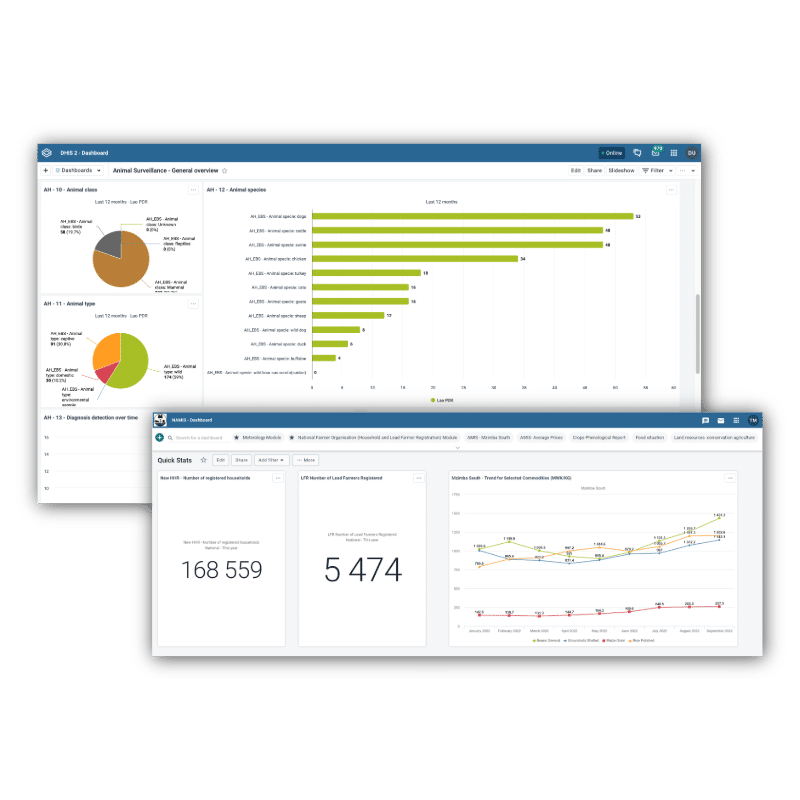
- Build dashboards to track agricultural performance, climate impacts, and program progress in real time.
- Disaggregate indicators by geography, crop type, farming practice, or climate zone.
- Calculate seasonal trends, cumulative outputs, and progress toward agricultural targets.
- Combine agricultural indicators with climate and environmental data to support decision-making.
- Export analyses easily for reporting, coordination meetings, and policy briefings.
- Predictive modeling through the DHIS2 Chap Modeling Platform.
Interoperability & extensibility
- Connect DHIS2 with external systems such as climate services, soil laboratories, and remote-sensing platforms through open APIs.
- Integrate data between DHIS2 systems such as animal health and disease surveillance to support One Health approaches.
- Reuse and adapt metadata to support diverse agricultural contexts without reconfiguring from scratch.
- Extend DHIS2 functionality to support emerging use cases such as carbon farming, resilience monitoring, and sustainability reporting.
Agriculture-specific use cases and examples
While the features above are broadly applicable, DHIS2 has already been adapted to support a range of agriculture-focused use cases across regions. The examples below show how countries can leverage DHIS2 for agriculture. To explore examples of related systems, visit our Animal Health and One Health webpages.
- National Agriculture Management System: Malawi supports small-scale agriculture and promotes food security using climate data in DHIS2, and Ghana has adopted DHIS2 for its national agriculture management information system.
- Agricultural Results Framework M&E System: Ethiopia has implemented a DHIS2 system for managing goals, outcomes, outputs and indicators of programs and projects that are organized through strategic and mandate thematic areas.Â
- National Animal Health Information System: Ethiopia is developing a DHIS2 system to strengthen animal health surveillance, improve data quality and timeliness, and support evidence-based decision-making.
Presentations & Abstracts
Watch informative presentations and read innovative abstracts for more detail on how DHIS2 is being used in the agriculture sector.
Enhancing Agricultural Resilience to Climate Change: A Data-Driven Approach with DHIS2
Agriculture and Climate Information Systems: Effective Disaster Preparedness and Access to Markets
NAMIS: Strengthening Practice & Policy
FAO’s support to animal health surveillance systems
Geospatial Analytics for Agricultural Productivity
An abstract from Edo State, Nigeria, accepted for the 2025 DHIS2 Annual Conference on using geospatial analytics and vegetation data to optimize agricultural planning and resource allocation.
AgroVAR pilots DHIS2 Tracker to support data driven future of carbon farming
An abstract from Agrovar, accepted for the 2025 DHIS2 Annual Conference, on boosting the sustainability and profitability of carbon farming.