
Gathering data on injuries and accidents during påske in Norway with DHIS2
The Norwegian Red Cross uses DHIS2 during the Easter holidays—when many people travel to the mountains and wilderness—to collect data on injuries and accidents, which helps illustrate the need for first aid and search and rescue preparedness and keep the public informed.
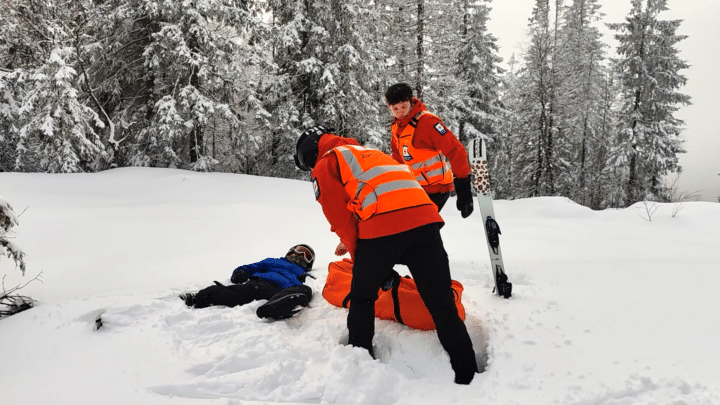
Påske (Easter) is one of Norway’s biggest holidays. Every year, approximately 33% of the population—around 1.8 million people—celebrate the holiday week by heading to the Norwegian mountains, where they can enjoy springtime skiing and sun far from city life. Due to Norway’s rugged geography, this also means that Easter is often an annual peak for accidents, particularly in remote locations that are far from hospitals and ambulance services.
The Norwegian Red Cross is a volunteer organization with approximately 40,000 volunteers across the country. Of these, around 5-6,000 are active in local Røde Kors hjelpekorps, groups that provide search and rescue services both alongside the police and official rescue services, in collaboration with other volunteer groups, and independently when the need arises.
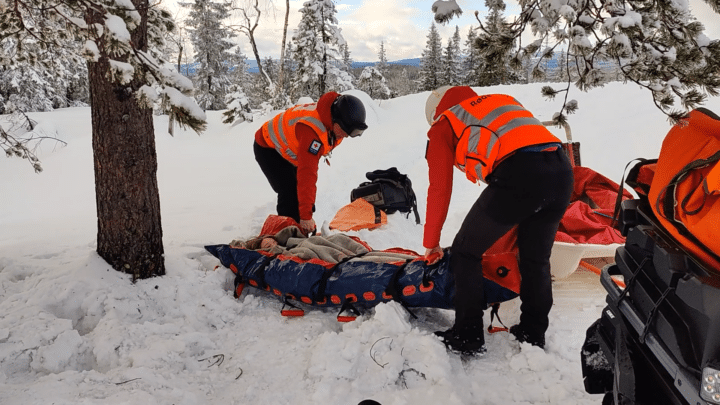
To help manage the potential surge in support requests during påske, the Norwegian Red Cross stands up temporary command centers at the national and regional levels that assist with preparedness and monitor Norwegian Red Cross activities during the holiday week. Since 2023, the Norwegian Red Cross has used DHIS2 for data collection, analysis, and reporting of injuries–at a much lower cost than the previous software system. The data from DHIS2 is used to provide an overview of injuries and incidents during Easter and to support messages conveyed to national media about the precautions one should take during outdoor recreation, especially in the mountains during Easter. In addition, the statistics are used in reports written by the Norwegian Red Cross.
A tradition of Easter accident reporting—improved with DHIS2
The Norwegian Red Cross has been supporting search and rescue and providing reports on accidents during the Easter holidays for years. Up until 2022, they were using a proprietary software system for data collection. In addition to being relatively expensive, this system had some limitations around access control and limited data analysis features which led to a significant amount of manual work. As a result, there was strong internal demand to replace this tool with a better and more cost-effective solution.
After considering several options, the Norwegian Red Cross technical team decided to try out DHIS2. At the time, DHIS2 was already in use by the Norwegian Red Cross’ international department for country missions—such as their work with the Ukrainian Red Cross—and reporting on patient data in country offices, which gave confidence that it could be deployed locally in Norway. In addition, the aggregate reporting and analysis requirements for the påske system were aligned with DHIS2’s core health information system use case, which has demonstrated success in countries around the world.
The fact that DHIS2 is both open-source and low-cost made it an easy choice—as Kultaran Singh, the Norwegian Red Cross’ IT Enterprise Architect who was responsible for getting the system up and running, put it, “It was a no-brainer.”
Providing regional and national oversight
The Norwegian Red Cross’ påske efforts are structured around a network of district coordination centers—18 in 2026, though the number can vary from year to year—and a national Easter command center. Each district office has the responsibility for reporting on the search and rescue activities of local volunteer groups, while the national office provides overall guidance and assistance.
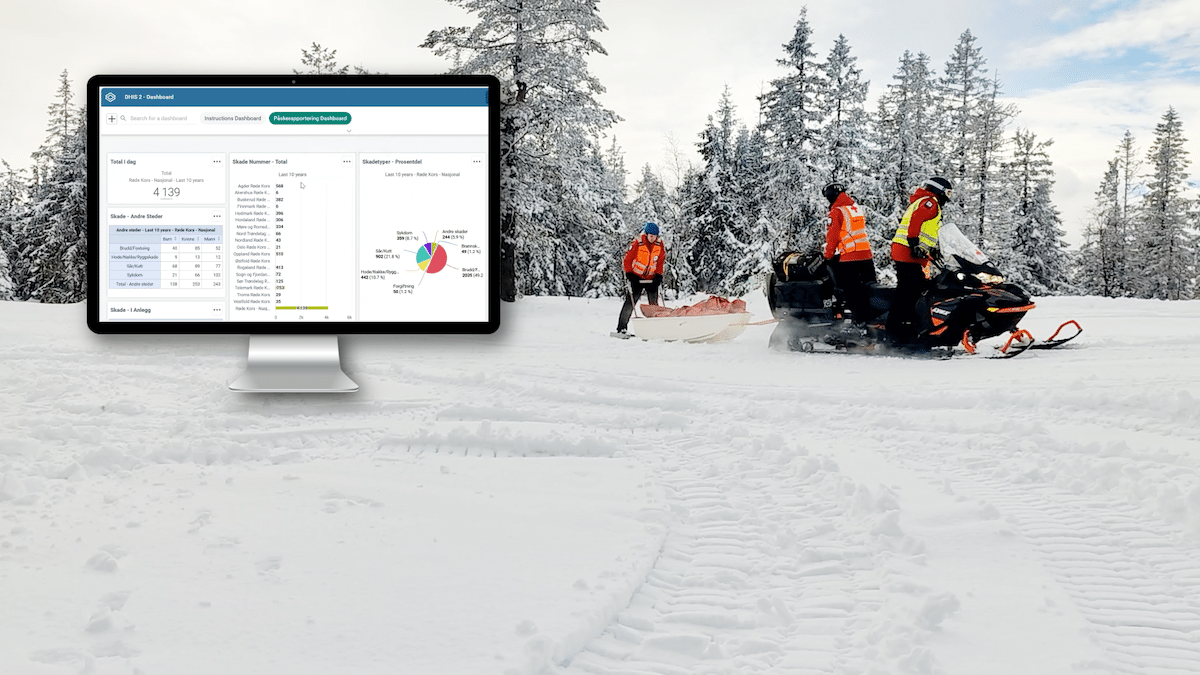
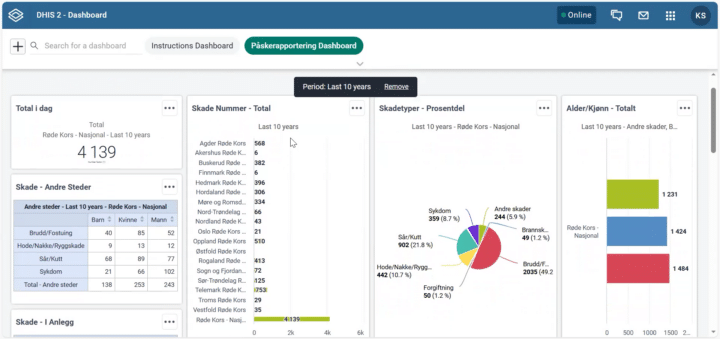
For reporting, the Norwegian Red Cross’ DHIS2 system uses daily aggregate forms that each district center is responsible for filling out that cover injuries and accidents that were handled directly by the Red Cross (accidents and missions that Red Cross respond to where the police/ambulance are first responders, are tracked in a different system). These forms do not contain personal information, but instead are tallies of key data points, such as how many accidents were reported on a given day, what kind of terrain they took place in, what kind of injuries were involved, and basic demographic details such as sex and age category (adult or child). The forms are not completed at the accident site, but are instead completed at the district coordination center based on reports called in from the search and rescue teams in the field.
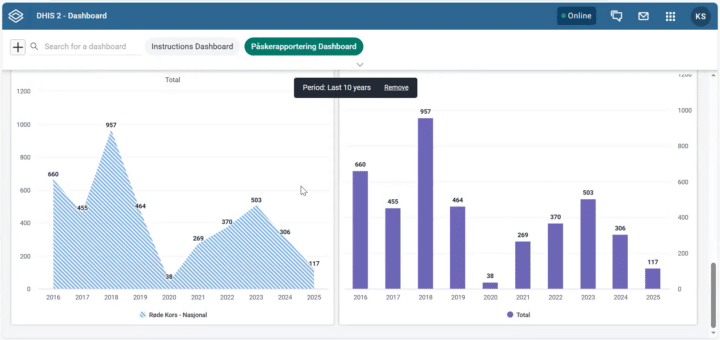
Once filled in, these reports are immediately aggregated in DHIS2, and the data can be viewed by the district offices and the national command center in dynamic DHIS2 dashboards. This allows Norwegian Red Cross teams to monitor trends of injury and other incidents during Easter, compare them to previous years, and to share information. Reports from DHIS2 are shared with the Norwegian news media to help keep the public informed of the local risk situation. They are also used internally at Norwegian Red Cross for statistical analysis.
Cost-effective cloud-based service customized to meet local needs
Because this DHIS2 system is only used during the Easter season, the Norwegian Red Cross team was interested in a deployment model that allowed them to save costs by only activating it when needed. They ultimately settled on a software-as-a-service model, using BAO Systems as a hosting and service provider, as well as for configuration support. Through this arrangement, they are able to activate the system in the weeks leading up to Easter to do refresher training, and then turn it off again once the holiday is over.
In the end, the DHIS2-based system costs the Norwegian Red Cross around 10% of what they paid for their previous system, providing both a significant savings and improved functionality that covers the entire workflow, from data entry to real-time visualization and aggregated reporting.
Based on their positive experiences with the system so far, the Norwegian Red Cross is interested in expanding their use of DHIS2.