Go to the main page

The DHIS2 Annual Conference takes place from 15-18 June 2026! Learn more

DHIS2 for Nutrition

Discover how DHIS2 supports routine nutrition monitoring, child growth tracking, acute malnutrition management, and maternal nutrition programs through integrated data systems, real-time analytics, and mobile data collection—using flexible digital tools adapted to national and subnational nutrition contexts.

Jump to a section on this page

    Overview: Strengthening nutrition information systems with DHIS2

    Nutrition programs require timely, integrated data to track child growth, manage acute malnutrition, monitor maternal nutrition, and inform evidence-based interventions. Digital platforms like DHIS2 provide a powerful foundation for collecting, managing, and analyzing nutrition data from health facilities, community-based interventions, and mass campaigns, while enabling integration with health, climate, and food security data.

    As a scalable and configurable platform, DHIS2 serves as the backbone for national nutrition information systems, supporting use cases such as growth monitoring and promotion, community-based management of acute malnutrition, maternal counseling, infant and young child feeding programs, vitamin A supplementation campaigns, and nutrition surveillance. DHIS2 enables countries and organizations to combine aggregate indicators, individual patient tracking, and geospatial data in a single, interoperable system—supporting decision-making from community level to national policy.

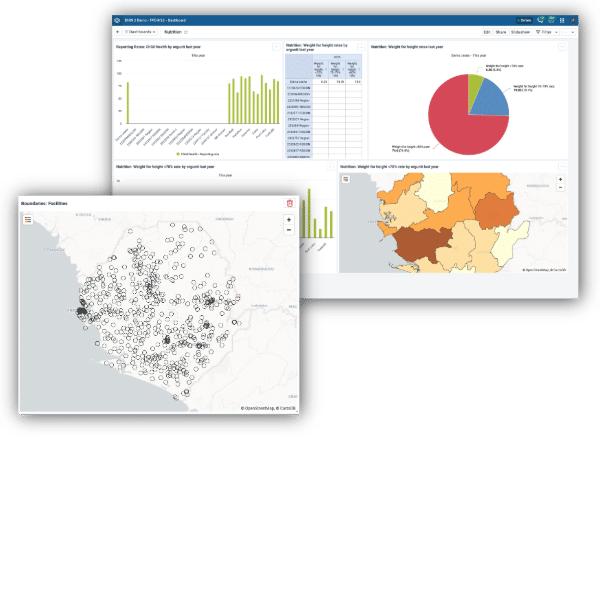
    The DHIS2 Nutrition toolkit, developed in collaboration with UNICEF, gives countries a practical starting point for integrating standard nutrition indicators into their national DHIS2 systems. It covers key intervention areas and includes dashboards designed to support analysis and decision-making at facility and community levels. 

    Nutrition monitoring in DHIS2 can also support cross-sector data integration, linking nutrition outcomes with food security, agriculture, water and sanitation, and climate data to facilitate comprehensive approaches to addressing malnutrition.

    Across diverse contexts, DHIS2 is being adapted to support nutrition resilience, program effectiveness, and data-driven decision-making, often in collaboration with ministries of health, international organizations including UNICEF and WHO, nutrition clusters, and implementing partners.

    DHIS2 Features for Nutrition Systems

    The DHIS2 platform includes built-in functionalities that support key aspects of nutrition data collection and analysis:

    Facility-, community- & campaign-based data collection

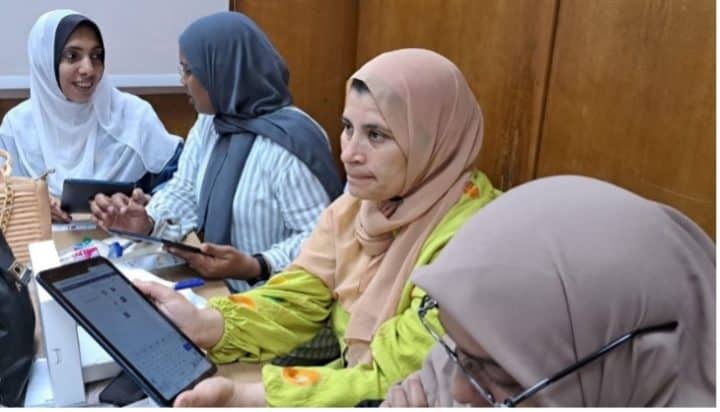
    • Collect aggregate nutrition data from health facilities using mobile devices with full offline support.
    • Report on multiple nutrition interventions including growth monitoring, vitamin A supplementation, infant and young child feeding counseling, and wasting treatment.
    • Organize mass campaigns such as vitamin A or iron-folic acid supplementation with event-based data capture.
    • Enable community health workers to report nutrition screening and referrals from the field.

    Explore data collection features

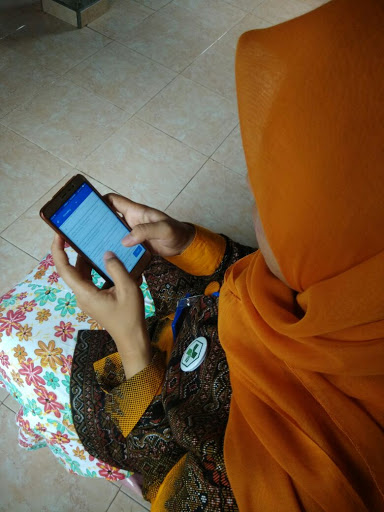
    Indonesia Android App

    Analysis & real-time monitoring

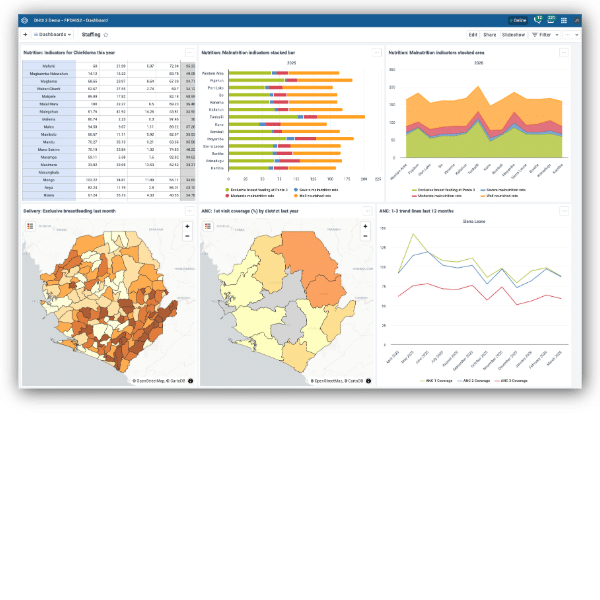
    • Build dashboards to track nutrition program performance, coverage, and outcomes in real time.
    • Monitor key indicators including exclusive breastfeeding rates, vitamin A coverage, wasting prevalence, and treatment outcomes.
    • Disaggregate indicators by geography, age group, sex, feeding practices, or nutrition status.
    • Calculate trends, seasonal patterns, and progress toward nutrition targets.
    • Generate nutrition scorecards to assess data quality and program performance.
    • Combine nutrition data with indicators on climate, food security, and health for integrated analysis.

    Explore analysis features

    Individual client tracking & continuity of care

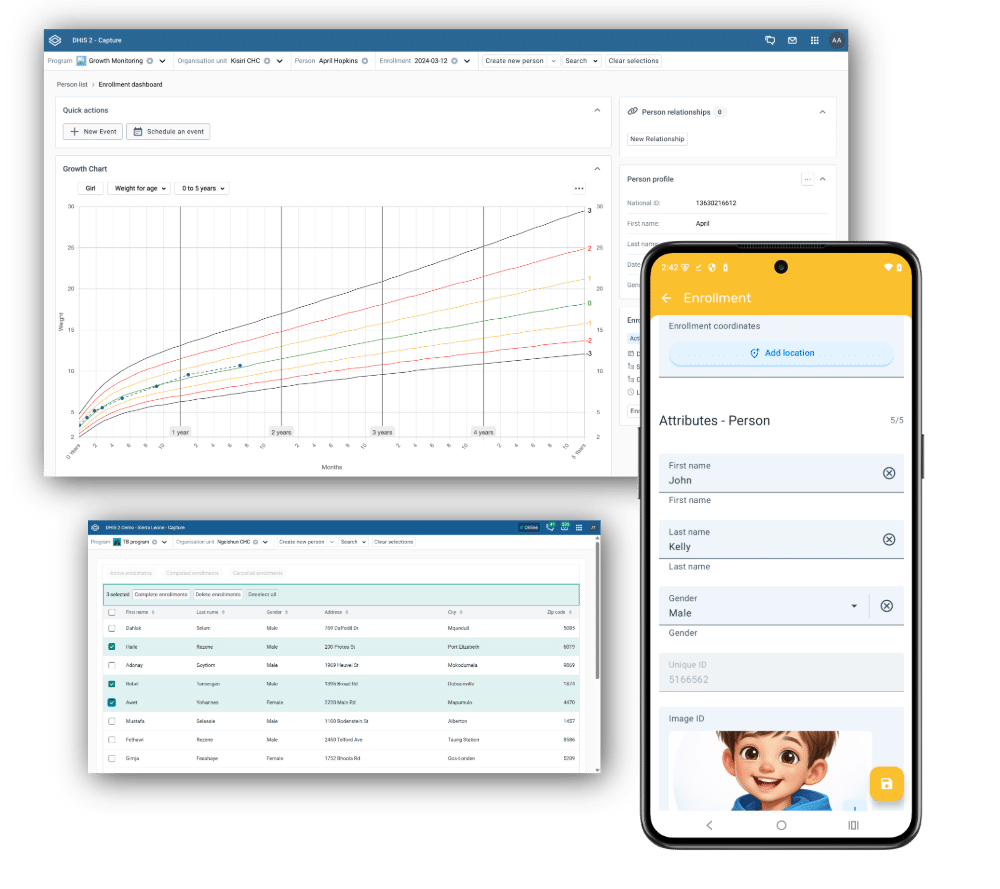
    • Register and track individual children, pregnant women, and lactating mothers through nutrition programs using Tracker workflows.
    • Monitor growth trajectories over time with automatic calculation of weight-for-height, weight-for-age, and height-for-age z-scores.
    • Follow children’s progress through therapeutic feeding programs from admission through discharge, tracking treatment outcomes.
    • Generate working lists to support community health workers in identifying defaulters and scheduling follow-up visits.
    • Capture anthropometric measurements with mobile devices at health facilities and community level.

    Geospatial analysis for targeting interventions

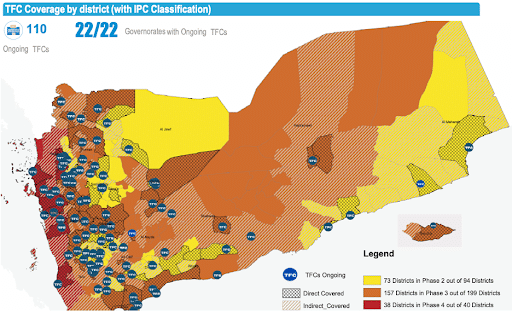
    • Map nutrition surveillance sites and therapeutic feeding centers with point data.
    • Visualize geographic distribution of malnutrition burden across administrative levels.
    • Identify hotspots and high-risk areas requiring targeted interventions.
    • Overlay nutrition indicators with climate risk, food security, and poverty data.
    • Track coverage of nutrition services by geographic area.

    Interoperability & system integration

    • Connect DHIS2 with other information systems through open APIs.
    • Integrate nutrition data with broader health management information systems for comprehensive analysis or with education data systems for school feeding programs.
    • Harmonize nutrition indicators across health, humanitarian, and development programs.
    • Support data exchange with humanitarian coordination systems including nutrition cluster reporting.
    • Reuse and adapt DHIS2 metadata packages to accelerate implementation.

    Explore extensibility features

    Nutrition use cases supported by DHIS2

    While the features above are broadly applicable, DHIS2 has been adapted to support nutrition programs across multiple regions and contexts. The examples below show how countries and organizations are leveraging DHIS2 for nutrition.

    • National nutrition information systems: Indonesia has used DHIS2 as its national data repository since 2018, integrating 13 fragmented nutrition and maternal and child health information systems across 514 district health offices and more than 12,000 facilities into a single unified dashboard.  
    • Growth monitoring and promotion programs: In Sri Lanka, public health midwives use a DHIS2-based Android application to enroll malnourished children, track anthropometric measurements over time, and flag household-level risk factors for referral.
    • Nutrition surveillance and early warning: Nutrition programs use DHIS2 to collect and analyze surveillance data, monitor trends in malnutrition prevalence, and support early response to emerging risks.
    • Humanitarian nutrition coordination: In Yemen, the WHO-led Health Cluster used DHIS2 Tracker to run case-based malnutrition surveillance across 300 facilities and manage therapeutic feeding programs for more than 415,000 children, helping reduce acute malnutrition prevalence among children under 5 from 29% to 21.4% between 2018 and 2020.
    • Nutrition monitoring for mobile and pastoral populations: In Ethiopia and Somalia, the ministries of health use a DHIS2 Tracker to monitor nutrition for migratory pastoral communities, maintaining continuous records for children under 5, pregnant women, and lactating mothers across borders.
    • School-based feeding programs: The World Food Programme uses the DHIS2 data capture app to manage school feeding data across 315 primary schools in Uganda’s Karamoja region, supporting daily meals for approximately 216,000 students.

    Resources & Documentation

    Get started with DHIS2 for Nutrition by using these helpful resources: