
HISP and Gavi: Strengthening immunization data use with DHIS2
The HISP-Gavi collaboration from 2018-2026 has helped LMICs advance strategies that leave no one behind with immunization through timely, integrated, and actionable data.
Gavi and HISP have collaborated to strengthen LMIC immunization systems since 2018. Thanks to a core investment in DHIS2 through HISP UiO, we have developed global software tools, guidance, and training resources to support immunization data availability and use. Through technical assistance carried out by local groups in the HISP network, we have provided targeted support to advance the implementation of these tools and build local capacity to use and sustain them.
This work has achieved results. 40 Gavi-supported countries now use DHIS2 as their main immunization data platform–up from only 7 when our collaboration began. These are fully integrated as national health management information systems (HMIS) and overseen by Ministries of Health. This integration enhances efficiency, interoperability, and sustainability. DHIS2 is now providing real-time access to immunization data insights, enabling stakeholders track coverage, vaccine stocks, cold chain status, and outbreaks of vaccine preventable diseases, facilitating evidence-based decision making.
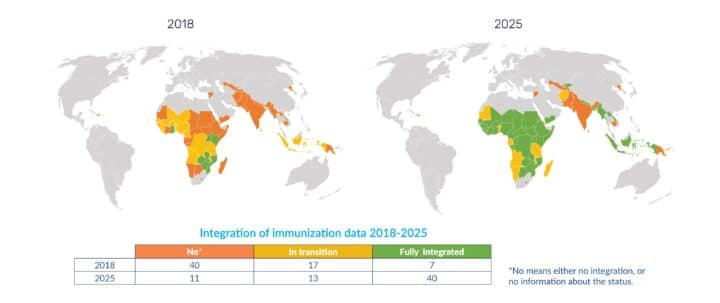
Strong collaborative efforts have led to implementation of campaign platforms, interoperability with eLMIS systems, and strengthening sub-national data use. Districts and facilities now utilize role-based analytics for targeted insights and efficient operations, strengthening governance, stewardship, and metadata management, while ensuring quality data, coordinated service delivery, and digital upskilling for their workforces. Data is guiding decisions on financing, operations, and equity.
This has helped make vaccination programs in LMICs more efficient and cost-effective–allowing them to do more with limited resources–and helped them reach an increasing percentage of their populations, saving lives.
Making an impact on global immunization priorities
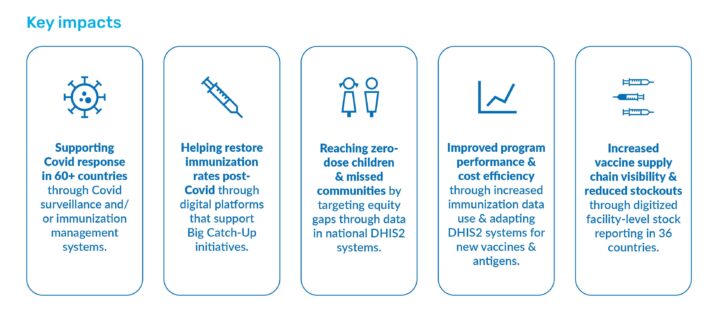
The Gavi-HISP collaboration has achieved measurable impact in key priority areas of Gavi 5.0:
Helping countries respond to the Covid pandemic by leveraging local DHIS2 infrastructure and capacity for rapid response. 50 countries–from Sri Lanka to Rwanda–quickly deployed DHIS2-based Covid surveillance systems, facilitating more effective response. In addition, 35 countries used DHIS2 for Covid vaccine delivery.
Restoring immunization rates post-Covid through digital support for Big Catch-Up initiatives. DHIS2 has played a role in helping countries close the post-pandemic immunization gap, including in large-scale campaigns in Bangladesh and targeted zero-dose and catch-up campaigns in Mozambique. A Global Big Catch-Up Monitoring Dashboard was also created using DHIS2, facilitating planning and readiness assessments, and supporting analysis of doses administered by age stratification to monitor coverage and make course correction.
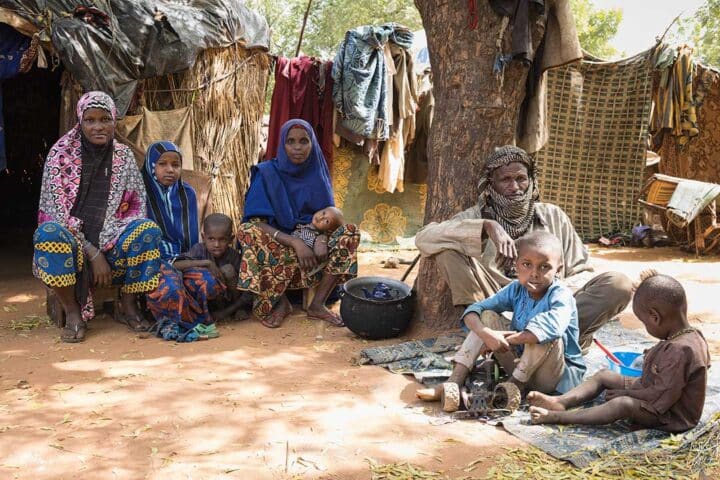
Reaching zero-dose children & missed communities by targeting equity gaps with real-time data. DHIS2 has enabled countries to identify, locate, and reach missed populations by linking immunization, geospatial data, and vaccine-preventable disease surveillance at scale. Notable examples include an MR campaign in the DRC targeting 62 million children and adolescents, data triangulation to identify immunity gaps and prioritize underserved communities in Rwanda, and containing a seasonal meningitis outbreak in Niger by using DHIS2 to optimize and track distribution of the new Men5CV vaccine—vaccinating 1.8 million people.
“With the monitoring of the second (Men5CV) campaign, we met every morning to go over the DHIS2 monitoring results. It was remarkable to see the difference in the ease of monitoring. We could see which teams were supervised and the common issues observed during the previous day. This led us to respond to the needs and quickly correct course when necessary.”
– Kalidou Moussa, National Supervisor, Agadez region, Niger
Improved program performance & cost efficiency by increasing immunization data use to drive results. As examples from Uganda, Kenya, and Rwanda show, routine immunization data use—when it is accessible and actionable—drives measurable performance improvements and cost efficiencies.
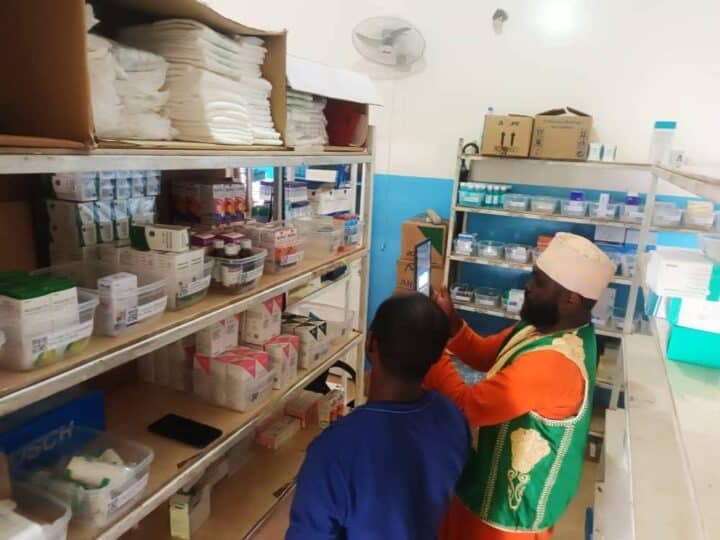
Increased vaccine supply chain visibility & reduced stockouts, supporting strong supply chains that enable equitable vaccine delivery. DHIS2 addresses a critical gap in facility-level vaccine stock visibility, empowering subnational teams to act. 36+ countries capture facility-level vaccine stock data in DHIS2 and several have integrated DHIS2 with a full-scale eLMIS for end-to-end stock visibility. In countries like Nigeria, this has helped drastically reduce stockouts of immunization commodities.
“The central medical store is able to see the stock levels through the health centers, which was not existing before.” With the new DHIS2 system, the Ministry of Health is “able to have visibility, end to end, from the medical products, from the lowest to the national level, so that we can avoid stock outs.”
– Amine Ahmed Chamsi, Data Scientist, Comoros Ministry of Health
Driving impact through local ownership, open-source, and networked support
The impact from our collaboration with Gavi has been driven by the HISP approach, which combines local collaboration and capacity building, development of open-source tools, and sharing of skills and innovations.
Networked technical assistance & local capacity building: The global HISP network has delivered coordinated, in-country support, enabling rapid dissemination of standards, tools, and skills. Between 2018-2025, local HISP groups provided support to 54 countries through Gavi TCA contracts coordinated by HISP UiO. This flexible mechanism has been highly valuable for countries, enabling HISP groups to respond rapidly to requests from Ministries of Health, helping them respond to crises like Covid, and creating the conditions for long-term collaboration with countries, which has helped build institutional memory, strengthen local DHIS2 capacity and ensure that system improvements were sustained. The results of this country-level work are too many to list, with concrete improvements in system performance and data availability across countries in Asia, Africa, the Middle East, and the Pacific.
Reusable digital public goods: Modular DHIS2 toolkits developed by HISP reduce costs and enable continuous system improvement without rebuilding solutions. Key DHIS2 enhancements that were developed through Gavi collaboration include improved immunisation analytics; alignment of the routine immunisation toolkit with Gavi’s priorities on zero-dose identification, gender-related barriers, behaviour and demand metrics; tools for logistics and cold chain; support for surveillance; use of DHIS2 for monitoring and assessing immunisation activities during mass campaigns; and expanded data triangulation capabilities allowing countries to cross-analyse surveillance, immunisation and logistics data within DHIS2. These global public goods were developed and made available as part of the open-source DHIS2 platform, while the TCA agreement functioned as a key mechanism to implement and adapt these enhancements within national systems, helping tailor the global tools to local needs and to ensure effective use of immunisation data from national to health facility level.
Looking ahead: Continuing to support Gavi’s strategic goals with DHIS2 & HISP
As Gavi transitions toward its next strategic phase, Gavi 6.0, DHIS2-supported immunization systems provide a strong foundation for country-led, resilient, and integrated delivery.
Targeted country engagements in Nigeria, the Democratic Republic of the Congo, and Somalia illustrate how digital public goods can support Gavi’s next phase—strengthening predictive vaccine supply chains, enabling fully digital and reusable campaign platforms, and sustaining immunization delivery in fragile and humanitarian settings.
While the HISP-Gavi collaboration during Gavi 5.0 has achieved significant impact in 40 countries, many of these countries require ongoing support to reach their immunization goals. The investments made thus far demonstrate how Gavi can advance equity, efficiency, and global health security under Gavi 6.0 through continued partnership with HISP and support for national DHIS2 systems. As Gavi’s internal reporting observes, additional investment in countries’ digital systems will maximize their potential for impact.
“Continued investment and adaptation are necessary to fully leverage digital tools for vaccination efforts and overall health management. Despite these obstacles, the combined technological and capacity-building efforts have contributed to a more robust and responsive health information ecosystem in the DRC. The adoption of DHIS2 has particularly improved health information system governance and capacity building. Local stakeholders report increased ownership of data-related tasks and motivation to use data for decision-making at all levels of the health system.”
– Leveraging Digital Health Information for Vaccination Programs in the Democratic Republic of Congo: A Case Study (p. 9)
Learn more: