
OpenHEXA & DHIS2
OpenHEXA streamlines data sharing and powerful analysis for DHIS2 users. It transforms raw DHIS2 data into secure, analysis-ready datasets that can be automatically shared with partners. The platform provides a single place for advanced data analysis, quality checks, and AI-powered insights, overcoming common challenges in data extraction and collaboration.
Jump to a section on this page
About OpenHEXA
OpenHEXA is a Digital Public Good offering a collaborative platform designed to help data collection systems and data analysts work together effectively. As a unified, secure environment, OpenHEXA ensures data sharing is traceable and transparent, which is essential for high-quality data analysis.
Working in secure workspaces, HMIS managers can extract data from DHIS2 and run automated pipelines for tasks such as data quality control, anonymization, and formatting. They can then share these refined datasets with analysts. Data analysts perform advanced analysis in their own workspace, only accessing the data they are entitled to.
Key users of OpenHEXA are:
- HMIS managers who want a simple, automated, and secured way to share data with partners. They can automate transparent data preparation and keep track of data access. OpenHEXA can be hosted on premises, allowing for strong data sovereignty and control.
- Data analysts who want a single tool to receive up-to-date data from various sources, develop powerful analytical code, and create high-quality data products to share with data users. OpenHEXA includes database and Superset integration and can prepare data for any Business Intelligence (BI) solution.
- Data users who need frequently updated and complex data products, as OpenHEXA facilitates routine data sharing, data augmentation, and complex analysis.
OpenHEXA transforms how data analysis is organized across organizations:
- Secure Workspaces: Organizations can create isolated environments for specific initiatives (e.g., “National Malaria Program”). Access is managed by Role-Based Access Control, ensuring governed and secure data access.
- Template Pipelines: Expert teams can create “Template Pipelines” for common tasks—like data cleaning or population coverage calculation—and share their methods and analytical recipes across different workspaces. Template pipelines from the community are available for every OpenHEXA user to use and enrich its analytic toolbox.
- Sharing “Analysis-Ready” Datasets: Instead of sharing raw, complex exports from sources like DHIS2, analysts use OpenHEXA to curate, clean, and annotate datasets. These refined datasets can then be shared directly with another workspace, external BI tools (PowerBI, Tableau), or via secure APIs.
- Data Sovereignty: OpenHEXA can be deployed on a country’s own national servers. This enables internal data sharing and complex processing without the sensitive data ever leaving the country’s physical infrastructure.
OpenHEXA is a Strategic DHIS2 Technology Partner.
DHIS2 use case
In a standard DHIS2 set-up, sharing data with external partners (like operational partners, funders, or academic institutions) is often complex. It is challenging to run complex exports, prepare the data into the required format, ensure quality, and automate the entire process.
OpenHEXA facilitates and simplifies this process. For a typical HMIS, the workflow looks as follows:
- DHIS2 Data Read: Using a predefined automated process (pipeline) in OpenHEXA, the HMIS defines relevant data extractions. For example, routine extraction of malaria data, organizational unit metadata, or consolidated line lists for a surveillance program. As OpenHEXA can be hosted on premises, the data does not have to leave the HMIS infrastructure before it is ready to be shared.
- Data Preparation: Before sharing, the HMIS manager can program data preparation pipelines that will anonymize data, make specific aggregations, or run complex data quality checks.
- Data Sharing: The anonymized, cleaned dataset is automatically pushed to the workspaces of authorized analysts.
- Data Integration and Analysis:
- Line List data is pushed daily to the Emergency Operations Center, which integrates it with laboratory data to run outbreak modeling.
- Malaria data is pushed monthly to the National Malaria Control Program workspace for reporting. It also integrates DHIS2 data with rainfall data to update a malaria outbreak forecast model.
- Organizational units data is pushed yearly to partners for national health system mapping.
- Data Products and AI. Analysis results can be presented using the Superset dashboard tool within OpenHEXA. Additionally, data users can now ask questions about DHIS2 data using AI (Large Language Models) directly from OpenHEXA. AI can also guide the development of data processes and analysis.
Real-world examples
- Democratic Republic of Congo (DRC): OpenHEXA serves as the dedicated data integration and analysis platform for the National Public Health Institute. It supports a One Health approach by securely centralizing data from key institutions, including routine HMIS DHIS2 data, line lists (e.g., for Mpox), and external environmental data (e.g., climate data, animal health surveillance data). This integrated data is used to generate analysis for outbreak monitoring—such as running outbreak detection algorithms and supporting the Mpox response—with results pushed to dashboards for decision-makers.
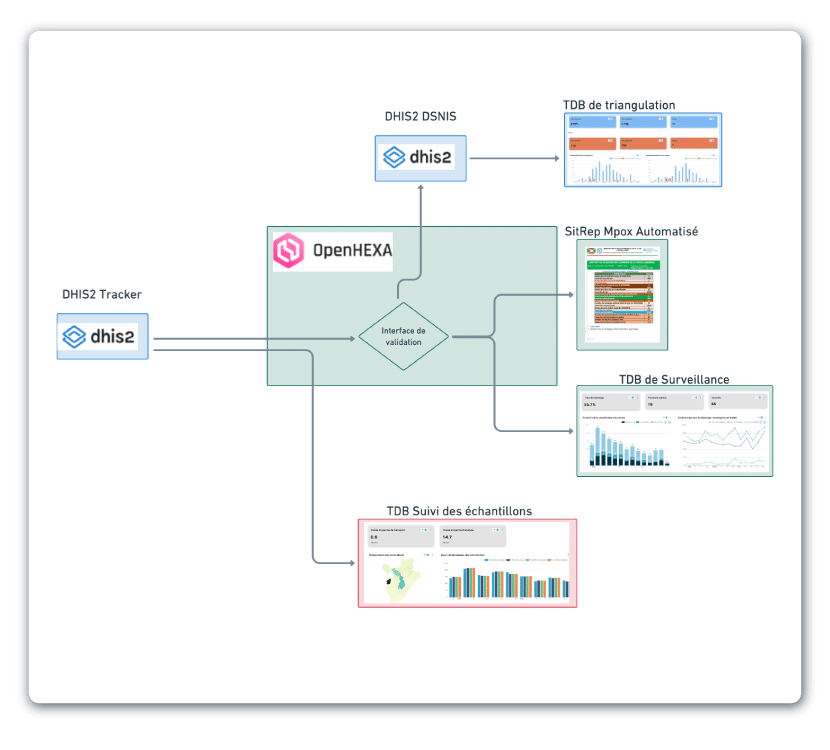
- Burundi: OpenHEXA acts as a dedicated data integration layer to ensure seamless data flow and coherence between the country’s two primary DHIS2 systems: the DHIS2 Tracker (for individual case-based surveillance) and the DHIS2 National Health Information System (HMIS, for routine aggregated data). The platform automates the secure, bidirectional exchange of data, ensuring individual case data is consolidated into the SNIS for reporting.
- Ivory Coast: In Ivory Coast, OpenHEXA functions as a core data integration infrastructure for the Ministry of Health (MOH). It creates an automated circuit that centralizes diverse national data sources, including multiple streams from routine HMIS DHIS2 and other systems. OpenHEXA processes this heterogeneous data—performing cleaning, matching, and indicator calculation. Notably, it harmonizes national DHIS2 data for automated import into the Performance-Based Financing HMIS (PBF HMIS) to allow for data triangulation and risk-based verification. The platform supports visualization through automated reporting and decision-support dashboards.
- Sub National Tailoring (SNT): OpenHEXA acts as a digital toolbox for the SNT process, automating the extraction and cleaning of data from DHIS2 and other sources to support subnational stratification. It enables programs to refine intervention packages based on local health contexts and budget constraints, using advanced analytics and impact modeling.
- National Malaria Data Repositories (NMDRs): OpenHEXA is the critical data integration and advanced analytics layer supporting NMDRs in six African countries (Burkina Faso, Burundi, Côte d’Ivoire, DRC, Mali and Niger. It builds automated processes (ETL pipelines) to securely extract, clean, and integrate heterogeneous sources like DHIS2 data, routine malaria surveillance data, georegistry information, supply chain, community health data and high-resolution climate data, and campaign data. OpenHEXA then transforms and prepares the data before pushing it to DHIS2 NMDR instances.