DHIS2 Climate & Health work in Ethiopia builds off existing DHIS2 infrastructure and capacity, while incorporating innovative DHIS2 tools for climate data integration and predictive modeling.
Health information systems & capacity
In Ethiopia, the Ministry of Health began working toward full national implementation of DHIS2 as a health management information system (HMIS) in 2017, with HISP Ethiopia as a key technical partner. As of 2024, data collection had expanded to cover all of the nation’s 30,000+ public health facilities, providing routine data on health services and outcomes for a population of more than 120 million people. At many of these facilities and health posts, data is collected on paper forms (due to infrastructure challenges such as lack of electricity, computers, and/or internet access) then recorded in DHIS2 at the district level, at which point it is immediately available for review and analysis. Weekly disease surveillance data covering notifiable diseases has been integrated into the DHIS2-based Public Health Emergency Management (PHEM) system. DHIS2 is also used to collect data on mortality, non-communicable diseases, and nutrition, among other programmes. National DHIS2 systems exist for animal health and are in development for agriculture.
At the national level, the Ministry of Health displays a high level of DHIS2 capacity. While reporting completeness in DHIS2 systems is fairly strong, timeliness and data quality vary across facilities, where there can be shortages of trained health information systems personnel, in addition to infrastructure gaps.
Climate data integration
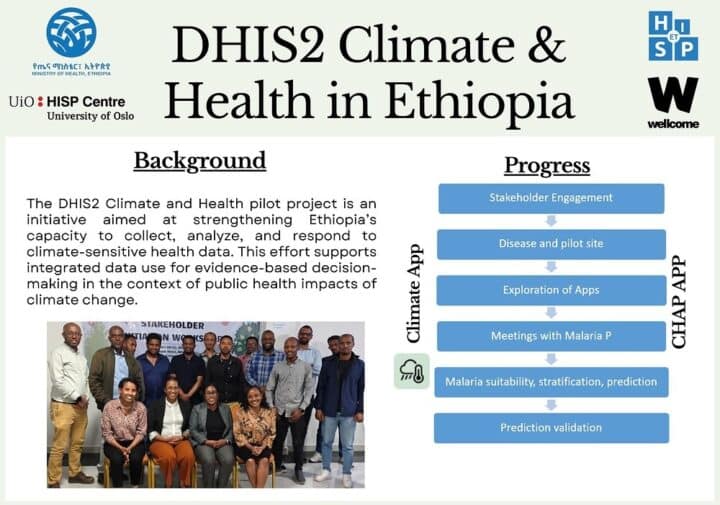
The DHIS2 Climate App has been installed in the national DHIS2 system, making ERA-5 reanalysis data available, including rainfall, temperature, relative humidity, and other variables. The MoH has also facilitated access to local weather data for malaria pilot sites through the Ethiopia Meteorological Institute (EMI). HISP Ethiopia is developing an integration pipeline for this data using DHIS2 Climate Tools that will enable sub-district analysis and support automated workflows.
Predictive modeling
HISP Ethiopia has installed the Chap Modeling Platform and DHIS2 Modeling App on a DHIS2 testing instance and tested the modeling framework and outputs, particularly for selected pilot sites. This testing and validation has focused on assessing climate-malaria relationships, prediction of malaria cases for upcoming months, generating early alert signals, and evaluating predictive feasibility at subnational level.