Go to the main page

Mozambique: DHIS2 Climate & Health Country Profile

Mozambique is exploring integration of climate data and predictive modeling capabilities into existing DHIS2 systems to support national climate and health priorities, with an initial focus on malaria early warning.

Jump to a section on this page

    DHIS2 for Climate & Health in Mozambique

    Mozambique was one of the 10 countries involved in the first phase of the DHIS2 Climate & Health project from 2024-2026. The ongoing work in Mozambique is being carried out in collaboration between the Ministry of Health, the National Malaria Control Programme, the National Meteorological Institute, and Saudigitus (HISP Mozambique). The current focus is on integration of climate data in national DHIS2 systems, refinement of predictive modeling approaches, and development of local capacity and governance structures to utilize climate-informed forecasting and risk mapping for more targeted malaria prevention interventions.

    Updated: July 2026

    Priority climate & health use cases

    In Mozambique, malaria has been identified as an initial focus area for piloting DHIS2 climate & health systems:

    • Climate-informed malaria risk mapping & early warning (piloting), integrating climate data into the country’s existing malaria surveillance system for district-level outbreak forecasting and trend mapping. The Ministry of Health is interested in expanding this system to cholera, diarrhea, and other diseases in the future.

    Information system infrastructure

    DHIS2 Climate & Health work in Mozambique leverages existing DHIS2 infrastructure and capacity, while testing innovative DHIS2 tools for climate data integration and predictive modeling.

    Health information systems & capacity

    DHIS2 was officially adopted by the MoH as a national health management information system (HMIS), locally known as SISMA, in 2015, serving as an integrated data platform for routine data across health programmes. Mozambique has a national malaria repository (iMISS) based on DHIS2 that includes campaign data, supervision data, epidemiological data, and entomological data, and also uses DHIS2 for disease surveillance, mortality reporting, community health, and nutrition programmes, as well as to support health logistics and supply chain management. Saudigitus provides technical assistance and capacity building support for national DHIS2 systems in Mozambique.

    An initial effort to deploy climate-informed DHIS2 malaria systems in Mozambique was carried out with support from the Clinton Health Access Initiative (CHAI) and Saudigitus, resulting in the development of a prototype dashboard. This could not be operationalized due to technical barriers by the time project funding ended in 2022. However, the lessons learned from this work were instrumental in informing the development of the Chap Modeling Platform by HISP UiO.

    The primary climate-health information product that Saudigitus has developed for Mozambique through their more recent work is a district-level predictive early warning system that integrates climate variables with iMISS/DHIS2 malaria surveillance data and produces a dynamic dashboard with 2–3 month district-level forecasts of malaria cases, spatial risk maps, and climate-malaria trend dashboards for program planning. This dashboard is currently a prototype, and has not yet been integrated into routine facility-level dashboards or operational decision making.

    Climate data integration

    The DHIS2 Climate App has been installed in Mozambique’s HMIS, enabling integration and use of climate data in DHIS2. As a starting point, 36+ months of CHIRPS precipitation and ERA-5 Land temperature data have been imported and harmonised to all 161 SISMA districts. National-level technical teams in the National Malaria Control Programme (NMCP) are currently the primary users of climate data in DHIS2, which supports climate-malaria relationship monitoring through time-series comparing rainfall, temperature, and humidity vs. case counts and analytical cross-tabulations between forecasts and monthly trends at district level.

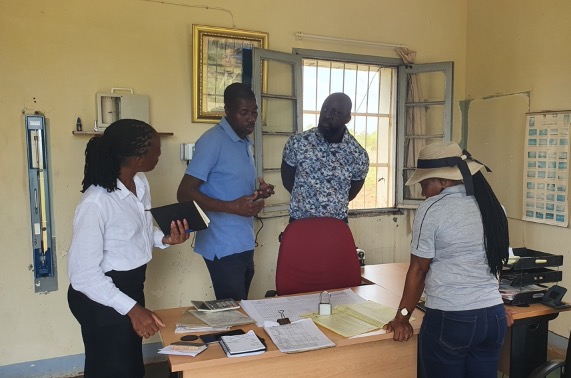
    Saudigitus has also collaborated with the National Meteorological Institute (NMI) of Mozambique to investigate potential solutions for digitizing local climate data, including piloting the use of DHIS2 to capture minimal data sets from local weather stations. This work is in an exploratory phase.

    Predictive modeling

    The MNCP’s operational goals for predictive modeling are to be able to generate malaria forecasts with a 2–3 month lead time to guide proactive interventions (IRS, ITN distribution, and resource allocation) to support a shift from detecting outbreaks to anticipating risk.

    Saudigitus has installed the Chap Modeling Platform and DHIS2 Modeling App on Mozambique’s DHIS2 production environment and conducted testing sessions jointly with the malaria program that have identified relevant models and data sources. These models have been evaluated in Chap and were found to be appropriate for district-level planning. During testing, Chap alerts identified three potential malaria surges in two provinces with a four-week lead time, which would be sufficient to enable data-driven shifts in IRS intervention timing. However, this system is not yet in operational use due to organizational and technical challenges. SOPs for early warning system alert response are not yet finalized, and there is low capacity for probabilistic output interpretation for the MNCP team. Data quality challenges included some missing data in rural districts and temporal misalignment between climate and health data. In addition, the use of multiple DHIS2 instances across different programmes causes interoperability challenges, and forecast generation has not yet been automated.
    Policies, partnerships & governance

    Mozambique has a well-developed policy landscape for climate and health, grounded in national priorities and supported by a network of partners.

    National policy

    Mozambique published its first Health National Adaptation Plan (H-NAP) in 2026. This document, which covers the period from 2026-2030, guides the country’s climate and health work, and includes several priorities related to national information systems, including strengthening early warning and alerts for climate-sensitive diseases and development of interactive dashboards; reinforcing surveillance, WASH, and nutrition systems with climate data; and leveraging the national HMIS (SISMA) for climate-health data integration and monitoring.

    Governance & coordination

    Saudigitus collaborates with Mozambique’s Ministry of Health and the National Meteorological Institute on climate and health work. They have planned a workshop with the MoH and other actors in the climate and health space to discuss current early warning system initiatives and facilitate coordination and use of a shared DHIS2 platform. They have also presented a roadmap for climate and health using shared DHIS2 & Chap infrastructure across all disease programmes to the Director of Planning.

    Partner & funding landscape

    Early work on climate and health in Mozambique was funded through the Clinton Health Access Initiative (CHAI). Funding for recent work on DHIS2 climate and health systems in Mozambique was provided by Wellcome through the HISP-led DHIS2 Climate & Health project. Wellcome has also funded the University of Minnesota “Digital technology for storm-related malaria response in Mozambique” project–Saudigitus is collaborating with this project team on implementation of their model in Chap. In addition, Mozambique is receiving catalytic funding for climate and health data integration from the Global Fund.

    News & updates

    Learn more about DHIS2 Climate & Health work in Mozambique:

    Conference Presentation: DHIS2 for Climate & Health in Mozambique

    During a session at the 2026 DHIS2 Annual Conference, Saudigitus presented an update on the DHIS2 climate and health work in Mozambique.

    Watch Recording

    News: HISP network to support 7 African countries with DHIS2 Climate & Health tools

    Through the Global Fund Climate x Health Catalytic Fund, HISP UiO and local HISP groups will help countries strengthen national information systems for climate-informed health programming and disease surveillance.

    Read More

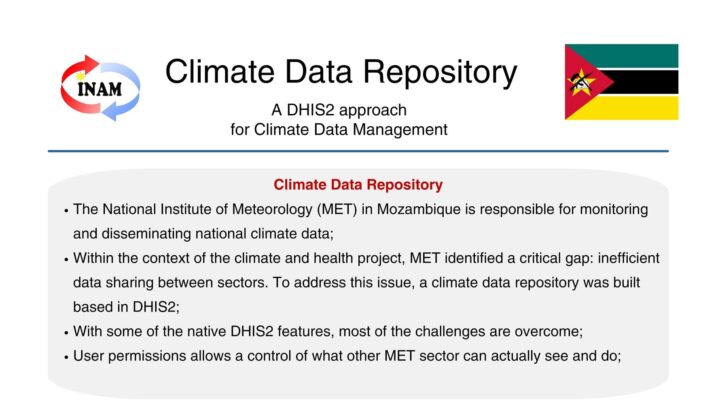
    Poster: Climate Data Repository: A DHIS2 approach for Climate Data Management

    Saudigitus presented a poster in June 2025 summarizing their exploration of digitizing climate data in Mozambique with DHIS2.

    Learn More

    Additional resources

    Explore these additional resources for more information:

    Contact

    Are you working on climate and health in Mozambique? We would love to hear from you. Contact the global DHIS2 Climate & Health project team at climate@dhis2.org, or connect with Saudigitus at: info@saudigitus.org