Go to the main page

Predictive Modeling & Forecasting in DHIS2

DHIS2 provides robust and flexible tools to enable the development, tailoring, evaluation, sharing, and use of AI-powered predictive models to generate analyses and forecasts for a wide range of diseases and other use cases.

Jump to a section on this page

    Improving analysis, forecasting & early warning through predictive modeling

    In the health sector, predictive modeling draws on existing health data, population statistics, environmental and weather data, and other variables, and uses machine learning to forecast future health events and operational demands. This can give advance warning of likely disease outbreaks, elevated health risks for vulnerable populations, and potential stockouts of key commodities. When used effectively, it helps health stakeholders shift from reactive interventions to more targeted planning and early prevention.

    DHIS2 now offers powerful tools that enable you to leverage existing DHIS2 data–combined with variables from a wide variety of sources through DHIS2 tools for data integration–for predictive modeling:

    • Chap Modeling Platform: An open-source software platform for disease forecasting that allows you to develop, access, import, train, tune, run, assess, and share predictive models leveraging the power of machine learning/AI with data from DHIS2 and other sources.
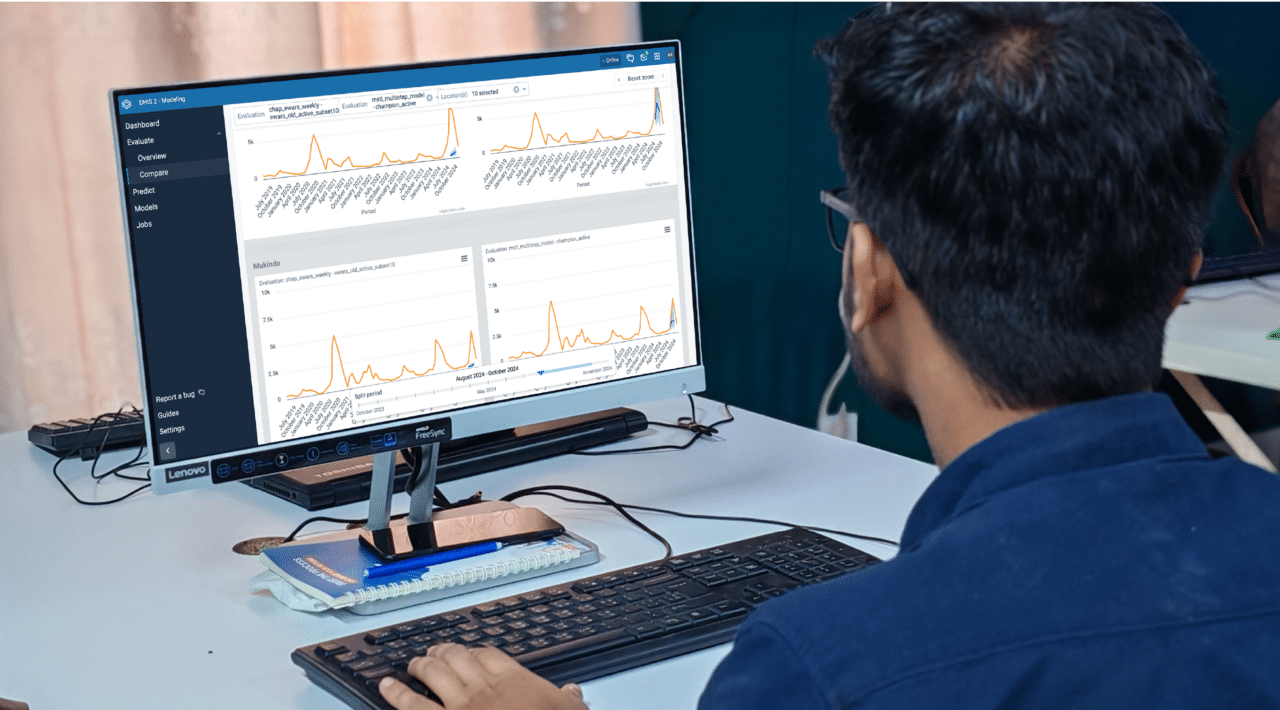
    • DHIS2 Modeling App: A user-friendly Chap interface within DHIS2 for selecting data to train predictive models, evaluating model accuracy, generating and visualizing predictions, and connecting forecasts to alerts that can inform action.

    These components work together: Chap pulls data from DHIS2, runs models, and pushes results back, while the Modeling App displays everything to DHIS2 users.

    Learn more

    These tools have been developed by HISP through the DHIS2 Climate & Health project. When used in conjunction with DHIS2 tools for climate data integration, they support forecasting of climate-sensitive diseases and health impacts–such as outbreaks of malaria and dengue, or increased risk for malnutrition or heat-related morbidity and mortality. They can also be used for disease modeling without climate data, or for forecasting of other health-related trends, such as predicting commodity levels to enhance supply chain performance. And they can also be used with DHIS2 systems beyond health, such as in the education sector.

    These solutions are currently undergoing iterative development by HISP UIO in collaboration with the local HISP groups of the HISP network and our country-level partners. They are open for testing by and contributions from the global DHIS2 community.

    Chap: Open-source, disease-agnostic platform for predictive modeling

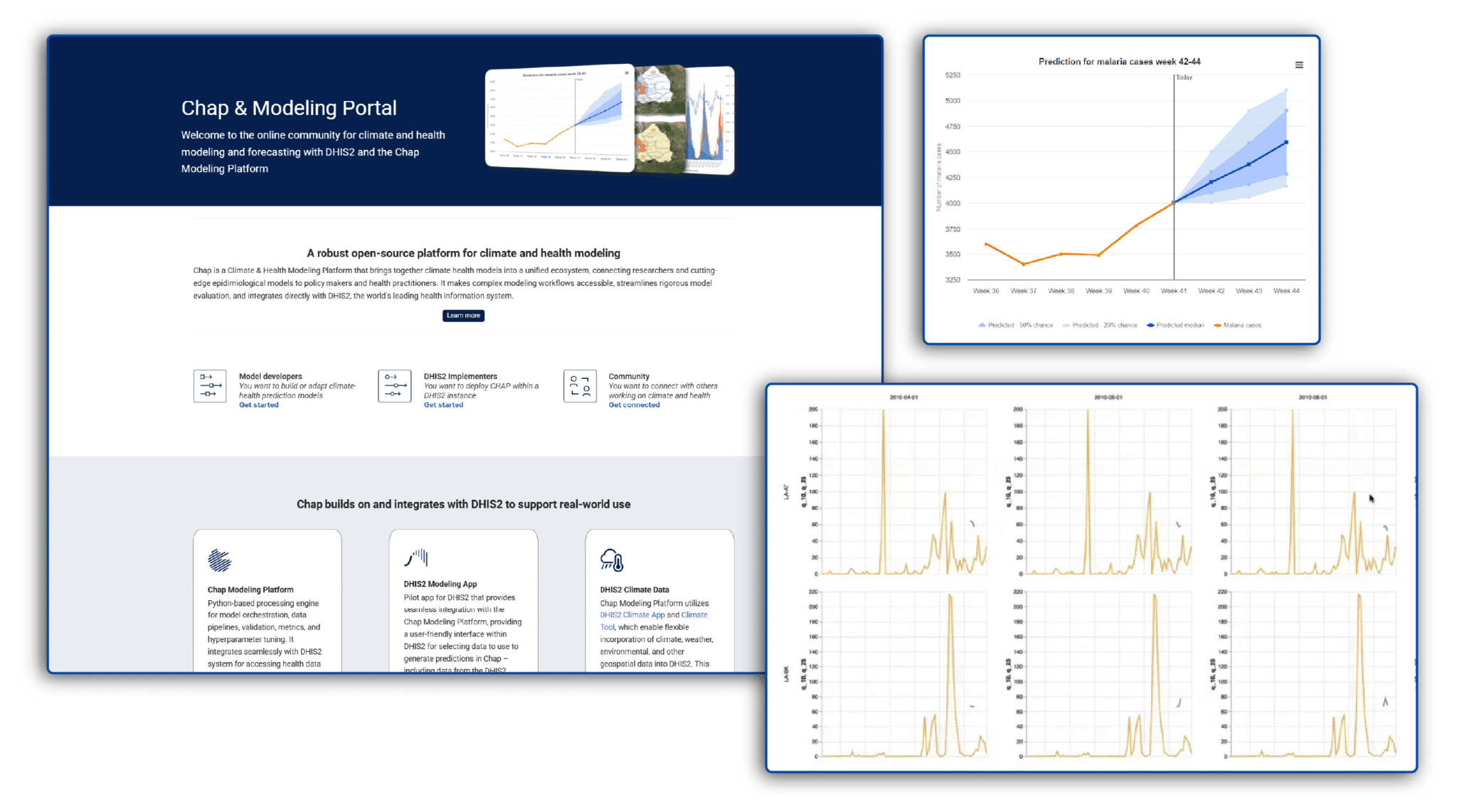
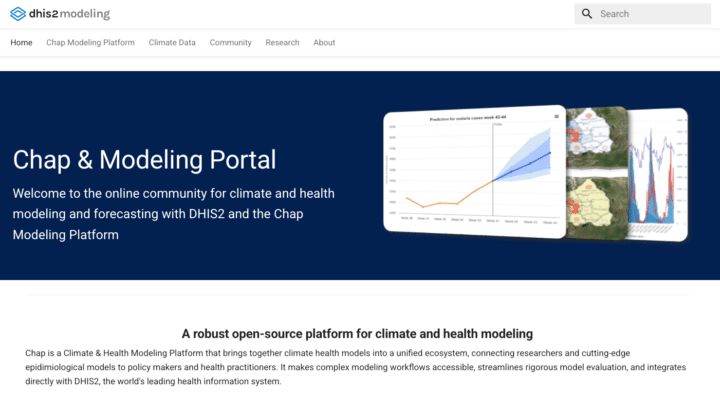
    The Chap Modeling Platform is a fully open-source software platform that brings together epidemiological models for a variety of diseases and contexts into a unified ecosystem, connecting researchers and cutting-edge models to policy makers and health practitioners. It makes complex modeling workflows accessible, streamlines rigorous model evaluation, and integrates directly with DHIS2, the world’s leading health information system. Chap can be downloaded and installed through the DHIS2 Chap & Modeling portal website.

    Chap aims to make health modeling and forecasting easier, better, and more impactful, and to empower health stakeholders in the global south to take ownership of the modeling process. Previously, the majority of predictive models have been developed by researchers–often based in the global north–for a specific disease and narrow geographical context, limiting their potential for reuse. This approach has commonly required health stakeholders to send their data out of the country for model development, testing, and forecasting–in conflict with many countries’ data sovereignty and privacy principles. Finally, these models have generally been designed around bespoke software, requiring expert knowledge to run and maintain, contributing to information system fragmentation, and creating barriers to routine operation use by health system actors.

    Chap addresses these gaps in several ways:

    • Chap is a platform, not a single model. It provides an ecosystem and software infrastructure in which many forecasting models–from different research groups around the world–can be shared using a standardized format, and plugged in, run, and compared using identical evaluation criteria. These models can be locally adapted and applied to different diseases and contexts.
    • The core principle is digital sovereignty. Models run inside a country’s own locally hosted Chap and DHIS2 infrastructure. Data never has to leave the national system for external analysis, and local stakeholders control who has access to forecasting outputs, and can fully tailor the system to meet their needs and align with their workflows.
    • Chap is designed for operationalization. Chap is built to function natively in the DHIS2 ecosystem. Disease data flows directly from national DHIS2 instances and forecasts are delivered back into DHIS2 dashboards through the DHIS2 Modeling App, supporting routine operational use by health system stakeholders.

    Chap is available for download as a Python package and is deployable within national infrastructure via Docker. Any model conforming to a standard format can be registered and run through Chap. Chap currently includes models ranging from simple seasonal baselines to Bayesian time series models to transformer-based deep learning architectures. Multiple international research groups have integrated their models into Chap.

    Learn more & get started

    DHIS2 Modeling App: User-friendly interface for Chap in DHIS2

    The Modeling App is a DHIS2 application–installed the same way as any other DHIS2 app–that provides a graphical interface to Chap for disease program staff. Through it, DHIS2 users can configure models, view training data, run forecasts, inspect evaluation dashboards, and compare model performance. It requires no separate software installation beyond DHIS2 and Chap, and plugs directly into the DHIS2 system the country already uses. It is available on the DHIS2 App Hub.

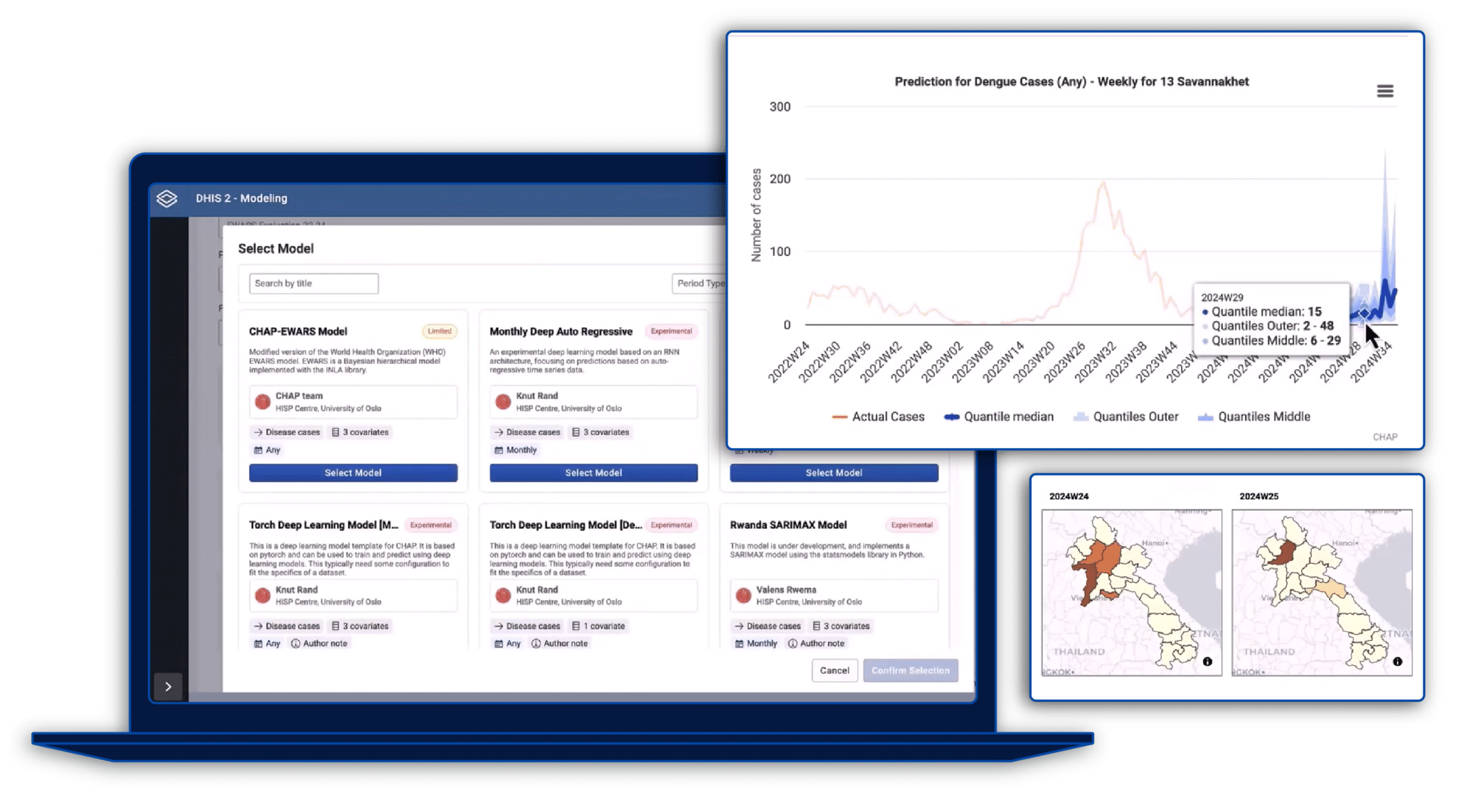
    Through the Modeling App’s intuitive user interface, DHIS2 users can select from all of the models that are available in Chap, including predictive models from leading researchers worldwide, or to build and configure custom models tailored to the local context. Users can select covariates and connect models seamlessly to DHIS2 data.

    With the app’s evaluation feature, users can backtest model performance against historical data, to assess how effective the model is at predicting trends. The app displays probability ranges for each prediction, giving a visual indication of how certain or uncertain a forecast is. The app also allows you to compare multiple models side by side.

    Once a model has been evaluated and validated, you can use the Modeling App to generate future predictions. These forecasts can be run for different time periods and geographic scales, such as three-month, district-level forecasts. Within the app, you can easily switch between viewing these results as a table, chart, or map, helping to identify which regions are at greatest risk for a given month. These outputs can then be seamlessly integrated into DHIS2 dashboards and configured to generate alerts when forecasts exceed locally defined thresholds.

    Learn more & download

    Resources & Documentation

    Watch presentations, read documentation, and explore other resources to learn more and get started using Chap and the Modeling App.

    Video: DHIS2 Modeling App & Chap

    Get a introduction to Chap and the Modeling App with this short video.

    Watch on YouTube

    Deep Dive: Chap & Predictive Modeling for Climate Health

    An in-depth presentation from the 2026 DHIS2 Climate & Health Academy.

    Watch on YouTube

    Chap & Modeling Portal

    Explore detailed documentation for Chap, find step-by-step guides for configuration and use, and learn more about designing and sharing models.

    Visit Chap Portal

    Share your predictive modeling needs & experiences

    DHIS2 tools for predictive modeling are continuously evolving to respond to emerging country needs and global knowledge. HISP’s work in this area is organized as a collaborative project. We invite contributions by everyone interested in joint development of data processing, machine learning and software to advance the field of health analytics, and we welcome input from DHIS2 implementers and users. Please share your questions, experiences, and ideas related to these tools and the use cases they support on the DHIS2 Community of Practice.

    Join the discussion