Go to the main page

Ethiopia: DHIS2 Climate & Health Country Profile

Ethiopia is exploring integration of climate data and predictive modeling capabilities into existing DHIS2 systems to support national climate and health priorities, with an initial focus on malaria risk assessment and early warning.

Jump to a section on this page

    DHIS2 for Climate & Health in Ethiopia

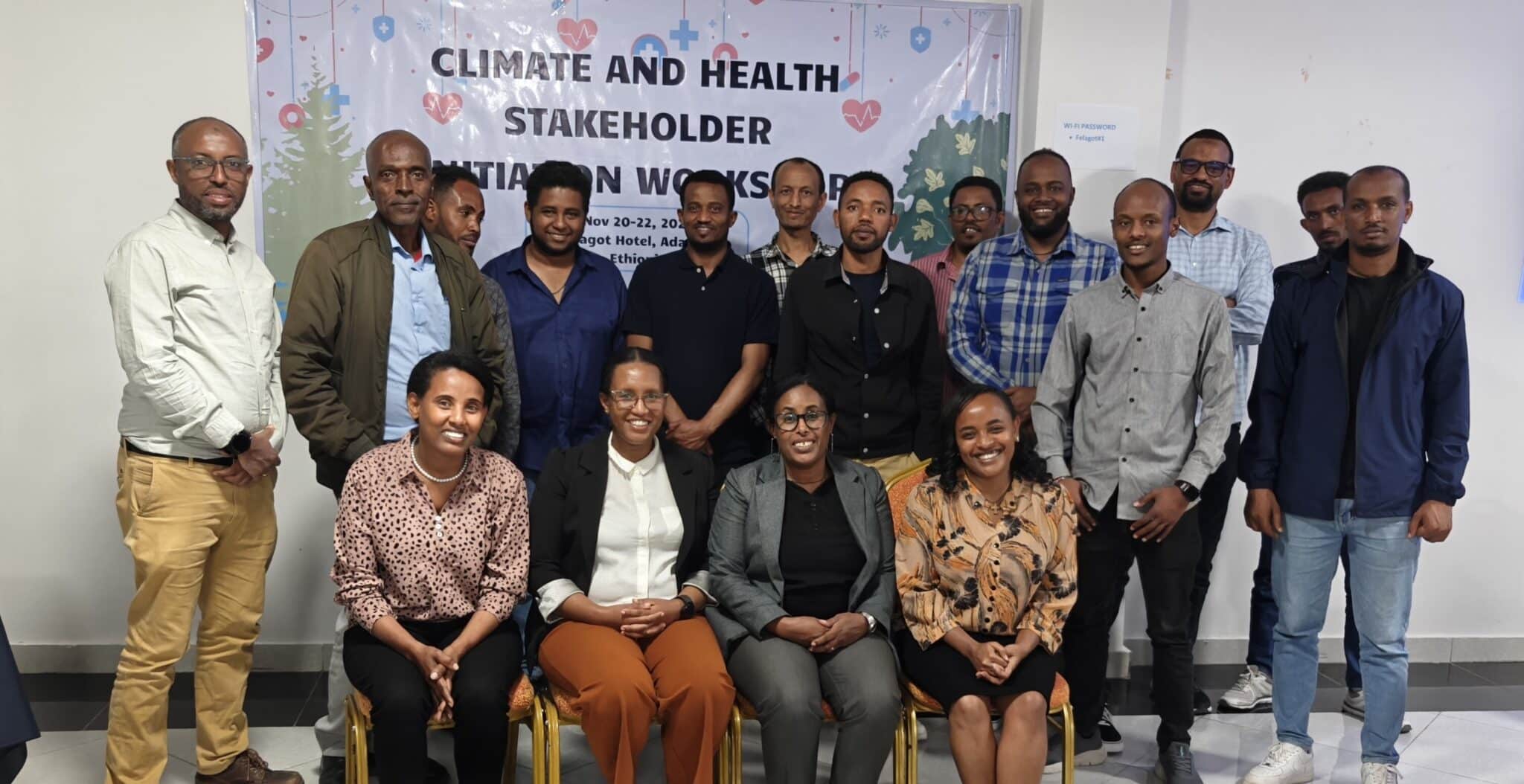
    Ethiopia was one of the 10 countries involved in the first phase of the DHIS2 Climate & Health project from 2024-2026. The work in Ethiopia has focused on stakeholder engagement and establishment of local governance structures with the Ministry of Health (MoH), Ethiopian Meteorological Institute (EMI) and other key partners, and co-creating frameworks for climate-informed health programmes focused on national priorities. Ethiopia continues to work on operationalizing climate-health data integration and initiating pilot activities with technical support from HISP Ethiopia.

    Updated: July 2026

    Priority climate & health use cases

    The Ethiopian Ministry of Health has identified two initial focus areas for piloting DHIS2 climate & health systems:

    • Climate-informed malaria risk mapping and early warning (pilot planned – pending resources) by integrating climate and routine epidemiological datasets to perform risk assessments and produce alerts in selected pilot districts.
    • Malnutrition early warning (concept in development) through combining data from nutrition and agricultural programmes with climate, socioeconomic, and other data sets.

    For the malaria use case, HISP Ethiopia has worked with MoH programmes and other key stakeholders from the national to the local level to conduct a needs and readiness assessment and co-create a pilot plan that has been approved pending identification of necessary resources. Two woredas in the Oromia Region have been selected for the pilot phase, including facilities in both lowland and highland regions to test performance in different geographies. The pilot will include developing digital solutions that support targeting malaria hotspots at the sub-district level, enabling actions that impact local communities.

    Initial exploration of the malnutrition use case led by HISP Ethiopia with local stakeholders revealed additional data needs and data quality issues that need to be addressed in order to develop a suitable approach. This use case requires additional investigation and development.

    Information system infrastructure

    DHIS2 Climate & Health work in Ethiopia builds off existing DHIS2 infrastructure and capacity, while incorporating innovative DHIS2 tools for climate data integration and predictive modeling.

    Health information systems & capacity

    In Ethiopia, the Ministry of Health began working toward full national implementation of DHIS2 as a health management information system (HMIS) in 2017, with HISP Ethiopia as a key technical partner. As of 2024, data collection had expanded to cover all of the nation’s 30,000+ public health facilities, providing routine data on health services and outcomes for a population of more than 120 million people. At many of these facilities and health posts, data is collected on paper forms (due to infrastructure challenges such as lack of electricity, computers, and/or internet access) then recorded in DHIS2 at the district level, at which point it is immediately available for review and analysis. Weekly disease surveillance data covering notifiable diseases has been integrated into the DHIS2-based Public Health Emergency Management (PHEM) system. DHIS2 is also used to collect data on mortality, non-communicable diseases, and nutrition, among other programmes. National DHIS2 systems exist for animal health and are in development for agriculture.

    At the national level, the Ministry of Health displays a high level of DHIS2 capacity. While reporting completeness in DHIS2 systems is fairly strong, timeliness and data quality vary across facilities, where there can be shortages of trained health information systems personnel, in addition to infrastructure gaps.

    Climate data integration

    The DHIS2 Climate App has been installed in the national DHIS2 system, making ERA-5 reanalysis data available, including rainfall, temperature, relative humidity, and other variables. The MoH has also facilitated access to local weather data for malaria pilot sites through the Ethiopia Meteorological Institute (EMI). HISP Ethiopia is developing an integration pipeline for this data using DHIS2 Climate Tools that will enable sub-district analysis and support automated workflows.

    Predictive modeling

    HISP Ethiopia has installed the Chap Modeling Platform and DHIS2 Modeling App on a DHIS2 testing instance and tested the modeling framework and outputs, particularly for selected pilot sites. This testing and validation has focused on assessing climate-malaria relationships, prediction of malaria cases for upcoming months, generating early alert signals, and evaluating predictive feasibility at subnational level.

    Policies, partnerships & governance

    Ethiopia has a well-developed policy landscape for climate and health, supported by a governance environment that is evolving with the active engagement of HISP Ethiopia.

    National policy

    The Health National Adaptation Plan (H-NAP) of Ethiopia for 2024-2028 provides a comprehensive framework to build a climate-resilient health system, reducing vulnerability to climate impacts while increasing adaptation capacity in the health sector. It references the need for DHIS2 digitalization and integration to enhance climate risk monitoring and surveillance. HISP Ethiopia has actively participated in Ethiopia’s H-NAP and Regional Health Adaptation Plan (RHAP) processes, ensuring alignment of the DHIS2 Climate & Health work with national climate and health strategies and priorities.

    Governance & coordination

    The MoH has facilitated data sharing agreements with the Ethiopian Meteorological Institute (EMI) to permit climate-health data integration. In collaboration with the Ministry of Health, HISP Ethiopia has helped to bring together stakeholders across the government for engagement in climate and health work, including all relevant MoH departments (such as malaria, disease prevention, and climate and health teams), Regional Health Bureaus, Zonal Health Departments, and the Ethiopian Public Health Institute (EPHI). Consultations with these stakeholders have resulted in a unified workplan for pilot implementation. While progress has been made in developing concepts for malaria forecasting, there is still a need to develop SOPs that would link forecasts to actions.

    Partner & funding landscape

    Ethiopia has a complex partnership environment, featuring engagement with a large number of donors, implementing partners, and local organizations. HISP Ethiopia provides advanced technical support for government-owned DHIS2 systems in Ethiopia. Funding for initial work on climate and health systems in Ethiopia was primarily from Wellcome through the HISP-led DHIS2 Climate & Health project. The MoH is working on obtaining resources to operationalize key parts of the H-NAP in the coming years, including the planned malaria pilot.

    News & updates

    Learn more about DHIS2 Climate & Health work in Ethiopia:

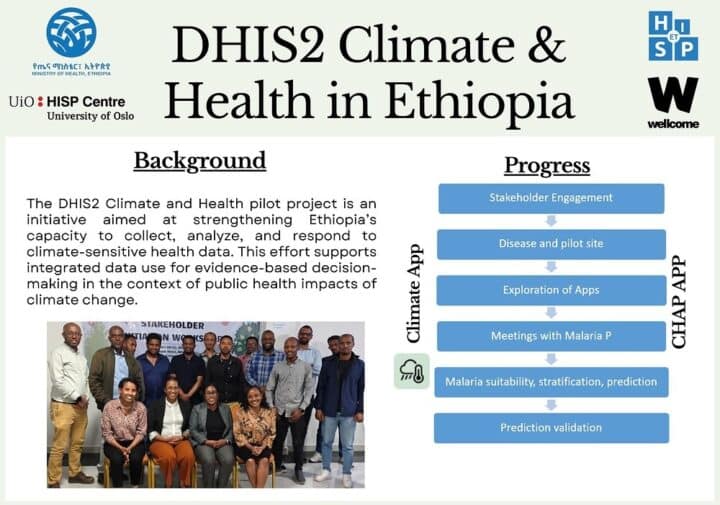
    Poster: DHIS2 Climate & Health in Ethiopia

    HISP Ethiopia presented a poster in June 2025 summarizing the country’s progress with DHIS2 for Climate & Health.

    Learn more

    Additional resources

    Explore these additional resources for more information:

    Contact

    Are you working on climate and health in Ethiopia? We would love to hear from you. Contact the global DHIS2 Climate & Health project team at climate@dhis2.org, or connect with HISP Ethiopia at bethelhem@hispethiopia.org