DHIS2 Climate & Health work in South Sudan builds on existing DHIS2 infrastructure and capacity, while leveraging innovative DHIS2 tools for climate data integration and predictive modeling.
Health information systems & capacity
DHIS2 has been used as South Sudan’s national health management information system (HMIS) since 2020, covering routine data on a range of health programs. DHIS2 is also used in South Sudan for disease surveillance, and for planning and management of ITN campaigns for malaria prevention.
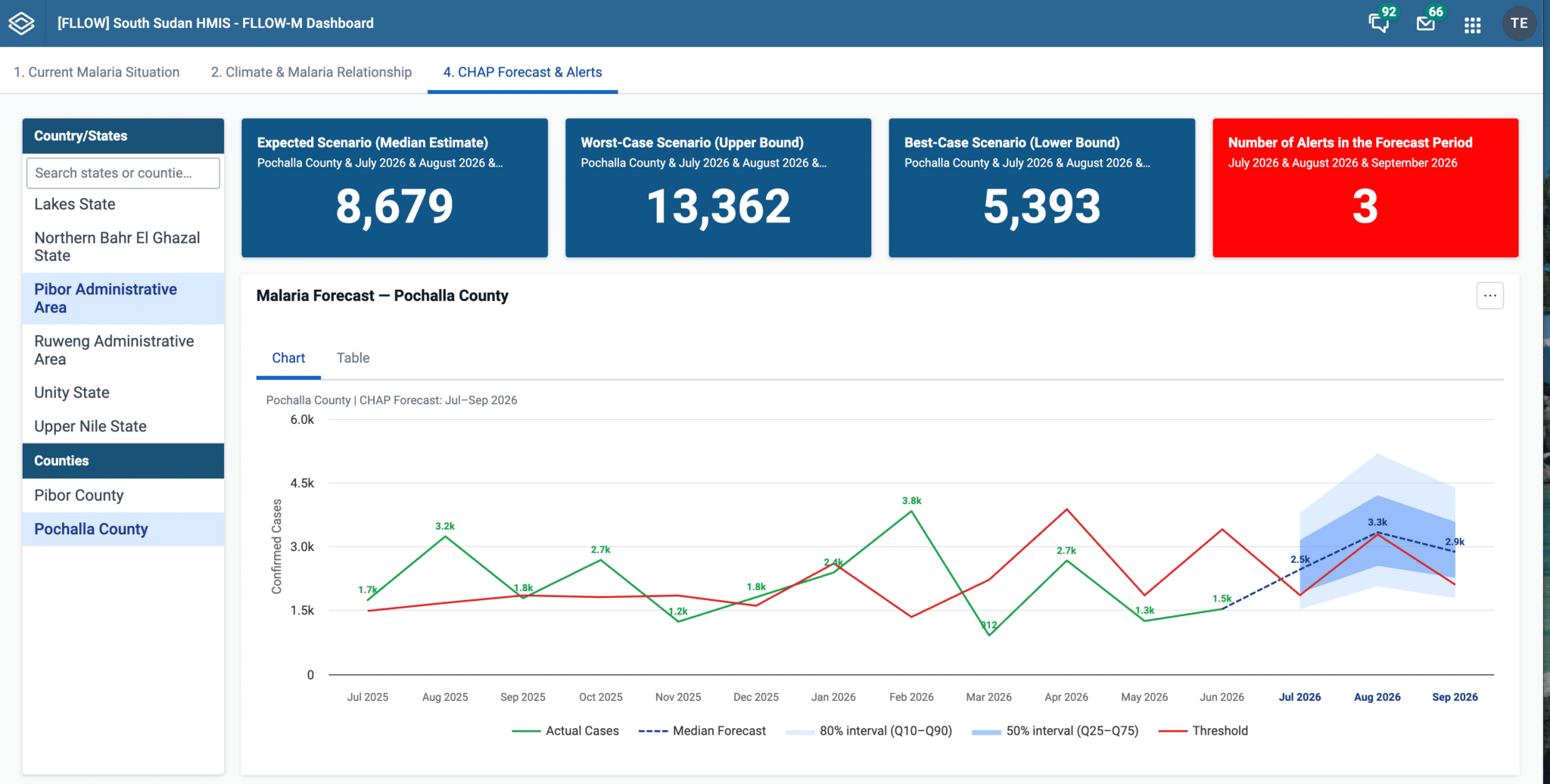
HISP Tanzania, in partnership with Malaria Consortium and the NMCP, has developed the FLLOW-M dashboard, a custom application within South Sudan’s national DHIS2 system that integrates historical malaria surveillance data with climate indicators to generate predictive risk analytics and automated outbreak alerts. The dashboard includes tabs that summarize malaria trends and allow stakeholders to track severe cases, and a section that shows climatic suitability for malaria across the country and analyzes confirmed cases alongside key climate variables: temperature, precipitation, and relative humidity. It also contains sections for assessing predictive models, displaying forecasts of predicted malaria cases in a range of scenarios, and sending alerts when outbreak thresholds are reached, helping stakeholders to plan targeted actions. A pilot of this dashboard was launched in July 2026, including local capacity building for dashboard use.
Climate data integration
The DHIS2 Climate App has been installed in South Sudan’s national DHIS2 instance, enabling integration of climate data and HMIS data in DHIS2. Temperature, relative humidity, and precipitation data are currently being drawn from globally available data sets, including ERA-5 Land and earth observation data. The import and harmonization of these data sets has been automated by HISP Tanzania using DHIS2 Climate Tools.
Predictive modeling
HISP Tanzania has installed the Chap Modeling Platform and DHIS2 Modeling App on the national DHIS2 instance in South Sudan and developed a custom middleware solution, Climate Automation & Prediction Scheduler (CAPS), to support the automated forecasting pipeline for the FLLOW-M dashboard.
In addition, based on the MoH’s interest, HISP Tanzania is working on a mechanistic model that can help analyze the cost-effectiveness of malaria prevention interventions based on predicted surges of malaria cases, to help assess whether additional mosquito nets should be distributed to specific areas during the country’s ITN campaigns.