

Introducing Open Climate Service: Self-Hosted Climate Data Infrastructure for DHIS2 and Chap
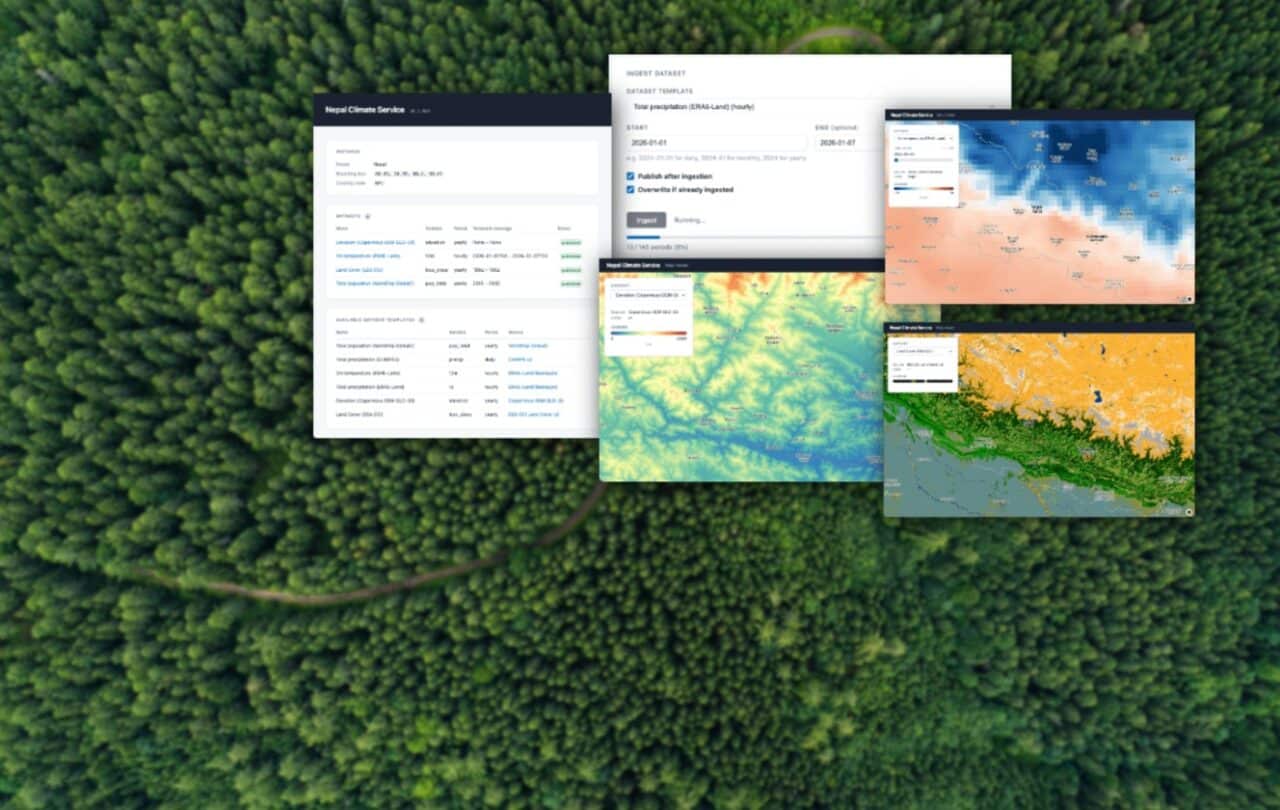
The new open-source software—under development by HISP—provides one place to collect and update rainfall, temperature and population data for DHIS2 Maps, the DHIS2 Climate app and Chap.
Open Climate Service is a new open-source platform that integrates data from many different sources to produce tailored climate services to help make informed decisions, manage risks, and adapt to climate change. It is being developed by the HISP Centre at the University of Oslo, together with HISP groups and country teams across Africa and Asia.
This kind of climate data is rarely easy to work with. Rainfall, temperature and population datasets come from many different providers, each with its own formats and update cycles. With Open Climate Service, a country team runs a single service that keeps those datasets up to date for its own country and delivers them to DHIS2 Maps, the DHIS2 Climate app and Chap, so that none of those applications has to connect to every provider itself.
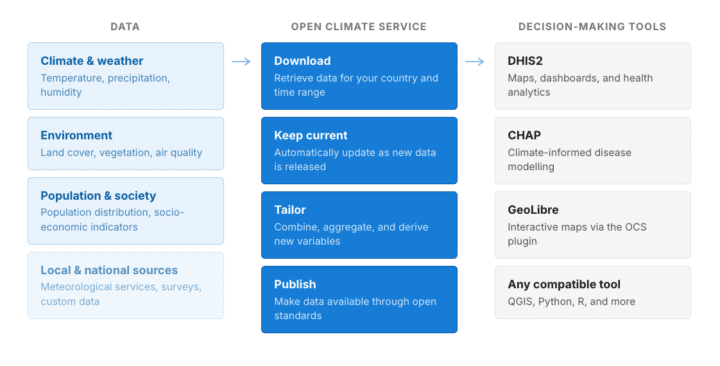
A country or region can currently set up Open Climate Service to:
- Access datasets such as CHIRPS rainfall estimates, ERA5-Land climate data and WorldPop population data
- Limit what it takes in and stores to its own country or region
- Keep those datasets up to date automatically on a schedule
- Summarize data by administrative or health service area
- Produce files ready for use in DHIS2 and Chap
- Add national or project-specific datasets of its own
Open Climate Service is designed to complement DHIS2 Maps and the DHIS2 Climate app while remaining independent of DHIS2. It can be deployed locally, in the cloud or on national infrastructure, so countries and organizations keep control over their data and their deployment choices, and can reduce their dependence on externally hosted Earth observation services. The broader goal is a reusable climate data layer that can also serve Chap, mapping tools and other systems.
Open Climate Service is under active development. Its interfaces and data models may still change, and the team is refining deployment, scheduling, workflow automation and integration patterns, which makes community feedback especially valuable at this stage. To read the full announcement, access the code and quick start guide, and share your feedback, visit the DHIS2 Community of Practice.