DHIS2 Climate & Health work in Togo builds off existing DHIS2 infrastructure and capacity and incorporates innovative DHIS2 tools for climate data integration, analysis, predictive modeling, and dissemination of tailored outputs to key stakeholders.
Health information systems & capacity
In Togo, DHIS2 has been used by the Ministry of Health since 2016 as the country’s Health Management Information System (HMIS), their main data collection and aggregation tool and national repository for health data. Togo also uses DHIS2 for infectious disease surveillance and for monitoring prioritized non-communicable diseases such as hypertension. The Ministry of Agriculture and Livestock and the Ministry of Environment has also been involved in piloting a DHIS2-based One Heath platform for Togo. These systems are owned and maintained by the MoH, with technical support from HISP WCA.
Through the DHIS2 Climate & Health project, HISP WCA has worked on several DHIS2 system enhancements and outputs:
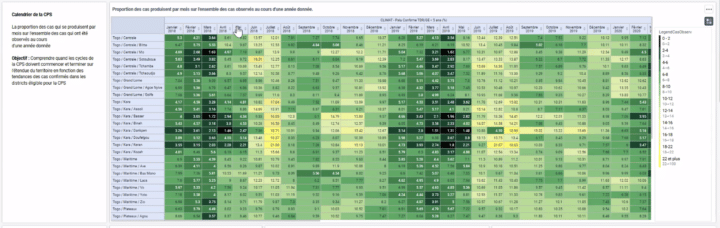
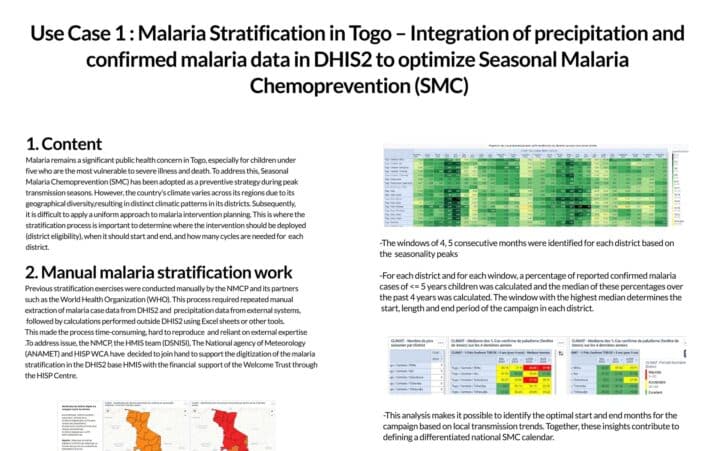
- SMC Stratification Dashboard: Strategic dashboard to plan district-level SMC campaigns based on the correlation between real-time climate data and historical malaria data, transforming a previously manual process that was carried out at intervals of 3 years or more into an automatic process in DHIS2. This effort included the development of the Climate Peak App, which identifies the peak precipitation months for each district throughout a year.
- Climate-Sensitive Diseases Dashboard for routine climate-health analysis, co-designed with the MoH HMIS, NMCP and surveillance program teams.
- Monthly Climate & Health Bulletin: A monthly nationwide bulletin published by ANAMET with expert input from NMCP, surveillance teams, university researchers, and HISP WCA.
Climate data integration
The DHIS2 Climate App has been installed in the national HMIS and malaria repository systems, and provides health stakeholders access to global datasets such as ERA-5, which are also shared with ANAMET for validation and use. HISP WCA is working using DHIS2 Climate Tools to automate the ingestion of ERA-5 data into the national malaria repository, specifically focused on temperature, rainfall, and humidity, and to provide gridded environmental data at the district level.
Predictive modeling
A central question guiding Togo’s work on predictive modeling with DHIS2 is how to predict malaria cases at the district level to enable the MoH to allocate sufficient resources and drugs several months ahead of need. HISP WCA has installed the Chap Modeling Platform and DHIS2 Modeling App on a DHIS2 staging instance that includes HMIS and intervention data, and has worked with the National Malaria Control Programme to identify key variables, test various models, and validate framework for malaria case prediction to address issues with historical data inconsistency and ensure district-level accuracy. The next steps are to integrate the operational model into DHIS2 and design an alert and notification dashboard using predictive data, working with the NMCP to define action thresholds.