
Expanding cancer surveillance to 13 million across Rwanda with DHIS2
The Rwanda Biomedical Centre used DHIS2 to replace paper-based cancer registration, extending the national cancer registry’s reach from 1.2 million people in Kigali to more than 13 million nationwide, raising annual case registration by 54% in the first year alone and laying the foundation for a global DHIS2 cancer registry toolkit.
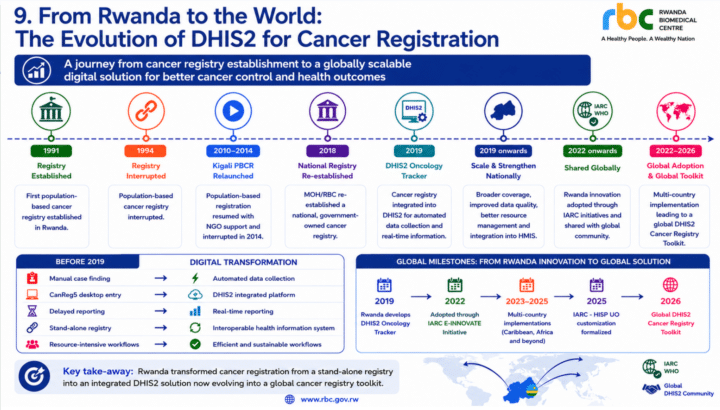
Before Rwanda established its national, government-owned cancer registry in 2018, cancer data collection was fragmented and largely paper-based. Registrars traveled to districts and hospitals, combed through patient files and pathology reports by hand, transcribed each case onto a form, and then sent those forms to the Rwanda Biomedical Centre (RBC) for review. Staff there checked for duplicates before entering the records into CanReg5, the cancer registry software developed by the International Agency for Research on Cancer. The process was slow, primarily covered Kigali, and left gaps in the data that health planners needed to understand the country’s cancer burden.
In 2019, the RBC, in coordination with the Ministry of Health and its partners, integrated cancer registration directly into DHIS2, which Rwanda already used at national scale for other kinds of health data. The new DHIS2 Oncology Tracker lets facility staff record patient, tumor, and follow-up data electronically at the point of care, with records flowing into CanReg5 for standardized coding, quality checks, and analysis. The shift gave health officials real-time visibility into cancer cases nationwide, instead of waiting months for paper forms to work their way through the system—and it gave hospitals access to their own data for the first time. The share of registered patients whose treatment outcomes are known and documented has risen from roughly 50% to at least 85%.
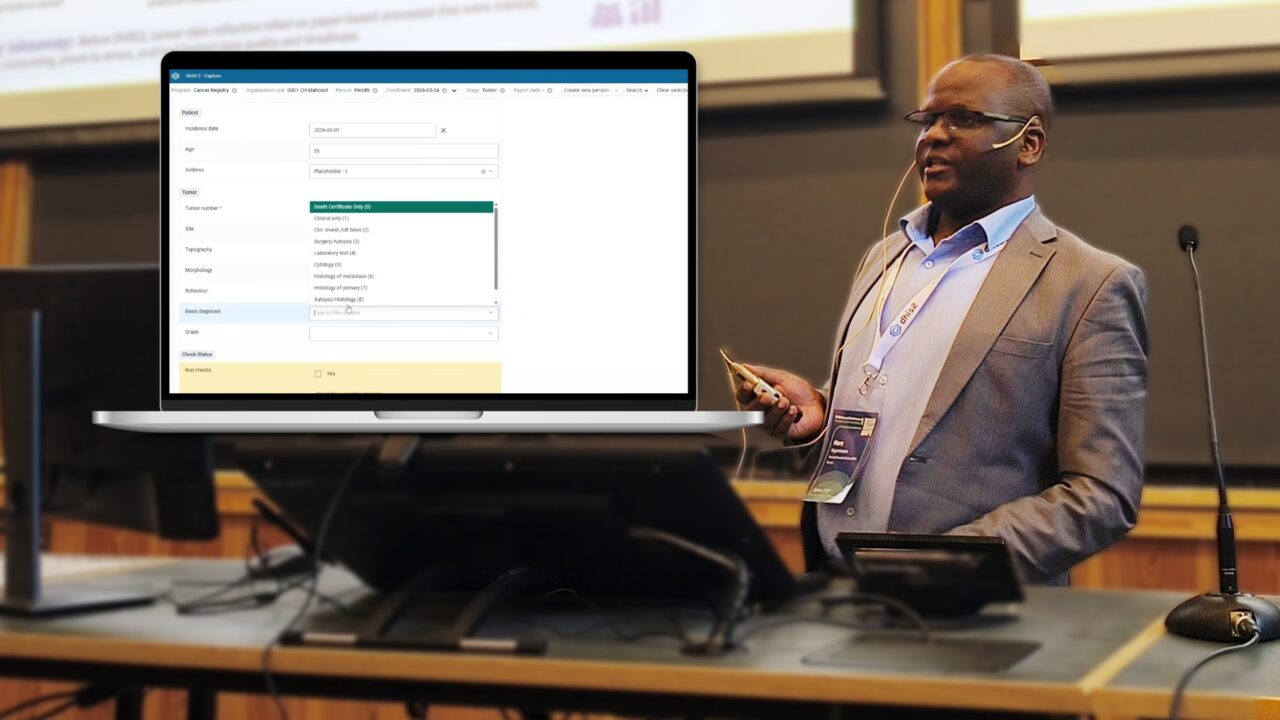
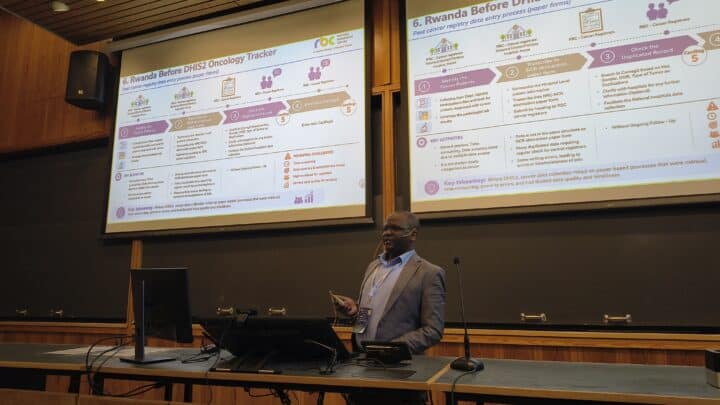
Registered cases rose from 3,284 in 2018, the last full year of paper-based reporting, to 5,071 in 2019, the first year of digital reporting—an increase of 54% in a single year—and have remained above 4,900 every year since. The registry has logged more than 57,000 cancer cases since 2007, with nearly half of those recorded in just the past five years. During his presentation at the 2026 DHIS2 Annual Conference in Oslo, Marc Hagenimana, the head of Rwanda’s National Cancer Registry, said the new DHIS2-based system has multiplied the registry’s reach.
“After integrating our cancer registry into DHIS2, we are no longer sending those people out to different places, so we improved the coverage from Kigali city, which was covering only 1.2 million population, to nationwide scale, where we have a population of more than 13 million.” – Marc Hagenimana, Head of the Rwanda Cancer Registry, Rwanda Biomedical Centre
Digitizing Cancer Data at the Point of Care
Before 2019, identifying and registering a cancer case in Rwanda required multiple manual handoffs. Registrars searched hospital registry books and patient files for cancer diagnoses, cross-referenced pathology lab results, and transcribed findings onto standardized paper forms. Central registrars then checked each submission against existing CanReg5 records to catch duplicates, often needing to follow up with hospitals for missing details, before entering each case into CanReg5 by hand. The process limited cancer surveillance across the country, slowed the flow of data that clinicians and policymakers needed, and did not often provide any usable data back to the hospitals themselves.
Clinical staff also sometimes resisted using the paper forms, according to Hagenimana, because the work was seen as redundant. Healthcare workers had already documented the diagnosis in a patient file or an electronic medical record, and were then asked to write it out a second time. They were “not understanding why we are duplicating their work,” he said. But now with DHIS2, “they do this once.”
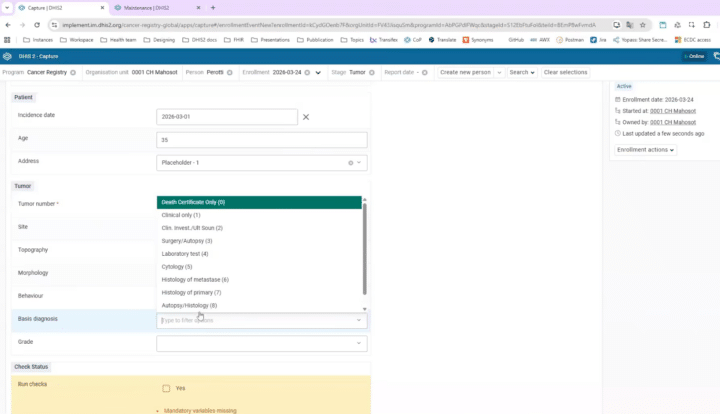
That single point of entry is the DHIS2 Oncology Tracker, developed by local implementation partner HISP Rwanda. Working within the DHIS2 platform Rwanda already operates nationwide, facility staff capture each case in four stages that track the patient’s care: a profile with identification, demographics, and contact details; tumor details including primary site, morphology, grade, and stage at diagnosis; the source of each piece of information; and follow-up, recording date of last contact, vital status, treatment status, and outcomes.
Because the record is updated over time rather than being filed once, it follows the patient through treatment instead of freezing at the moment of diagnosis. Nurses enter the data as part of the visit, and validation rules catch errors on entry—the system will not accept a prostate cancer diagnosis recorded for a female patient, for example. The data is transferred electronically to CanReg5, which handles standardized coding, deduplication, and registry-grade quality assurance before the data feeds into national analysis and reporting.
With this change, facilities can now see their own data for the first time. Hospital staff can build dashboards and run their own analyses, examining cases received by month, breakdowns by cancer type, and which patients are still in treatment, which have completed it, and which have stopped coming. When the registry lived only at the central level, it had very little effect on the people it was counting.
“As of now, (hospital staff) can use the registry to monitor their data, to see gaps, to see the status of patients, to make a follow-up, to do everything. Now this has contributed to improvement in the quality of care provided to cancer patients.” – Marc Hagenimana
That visibility appears to have changed patient follow-up. In an assessment conducted around 2018 and 2019, when the registry was still paper-based, the RBC could account for the treatment outcomes of only about 50% to 55% of registered patients. Since implementing DHIS2, the recent registry data puts that figure between 85% and 90%. The improvement is in documentation and in the ability to act on it—facilities can now identify patients who have dropped out of care and pursue them. Hagenimana said these figures are preliminary, and that the team hopes to secure funding for a formal study of the system’s impact on patient outcomes.
Streamlining Reporting to the National Level
Reporting now runs through 73 cancer registry focal persons across the country: five cancer diagnostic and treatment centres, 45 provincial and district hospitals, and 23 private hospitals, clinics and laboratories, alongside the vital statistics office. Every facility that diagnoses or treats cancer, public or private, reports into the same system.The shift is clearly visible in the registry’s own case counts. Registered cases had been climbing gradually under the paper-based system, from 633 in 2007 to 3,284 in 2018, as the RBC slowly expanded its manual case-finding effort. In 2019, the first year of the DHIS2 Oncology Tracker, registered cases jumped to 5,071—a 54% increase over the final year of paper reporting—and have averaged 5,314 annually from 2019 through 2025, roughly 62% above the 2018 level, according to centre data.
Digitizing also freed up money that can now be used to improve data quality. Collecting data on paper forms meant paying for vehicles, sending registrars into the field, providing food and other expenses. Those costs are now largely gone, and the central team that once spent its time traveling now spends that time working on data quality.
At the central level, staff calculate cancer incidence by combining registry data with population data from the National Institute of Statistics of Rwanda, and produce mortality rates by linking registry records to the national mortality database. The team also runs the data quality assessments that international cancer registries are measured by, and returns the results to facilities as feedback. Those measures include the proportion of cases confirmed by histology rather than by imaging alone, the proportion of records with a stage recorded at diagnosis, and the proportion of cases known only from death certificates. That last measure matters in a specific way for low- and middle-income countries, where, as Hagenimana put it, “most deaths are occurring out of health facilities.” A registry drawing only on hospital records will therefore systematically undercount.
After these assessments and analyses, Rwanda also submits its cancer data to the World Health Organization through the International Agency for Research on Cancer (IARC), and contributes to Cancer Incidence in Five Continents, the reference publication on global cancer incidence.
“Rwanda’s experience shows that countries can achieve high-quality, sustainable cancer surveillance by leveraging existing DHIS2 infrastructure and strong government leadership.” – Marc Hagenimana
Impact on Rwanda’s Cancer Goals
The registry now underpins a set of national health strategies that did not previously have reliable domestic cancer data behind them. Registry data feeds Rwanda’s health sector strategic plan, its strategic plan for noncommunicable diseases, the national cancer control plan, and the country’s cervical cancer elimination strategy. Researchers and universities also request registry data for their own studies.
“The introduction of the DHIS2 Oncology Tracker in 2019 enabled nationwide cancer surveillance, marking a significant step forward in Rwanda’s cancer control efforts.” — Rwanda National Cancer Registry
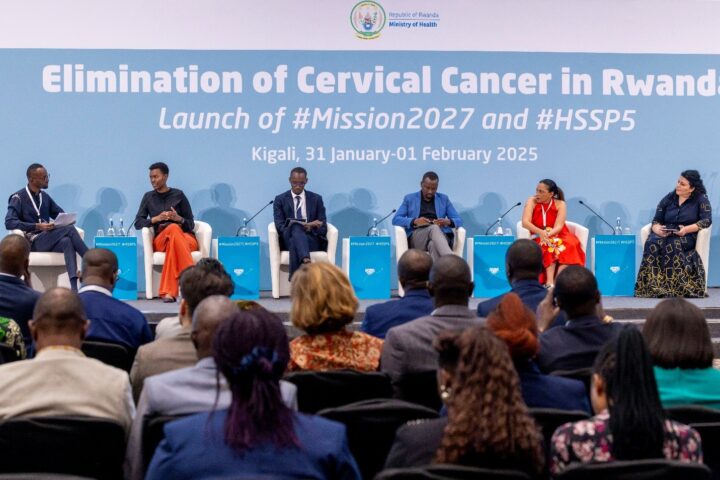
The cervical cancer work is an area of particular relevance today. Rwanda was the first African country to launch a national human papillomavirus (HPV) vaccination program, in 2011, and has maintained immunization coverage above 90% since that time. Following that launch, in February 2025, the Ministry of Health announced an accelerated plan to eliminate cervical cancer by 2027—three years ahead of the World Health Organization’s global target. Meeting that goal means vaccinating 90% of girls against high-risk HPV strains by age 15, screening 70% of women aged 30 to 49 using HPV DNA-based testing, and ensuring that 90% of women diagnosed with precancerous lesions or invasive cancer receive timely treatment.
None of those targets can be verified without a functioning registry. The World Health Organization’s elimination threshold is an incidence rate below four cases per 100,000 women and Rwanda’s rate stood at 28.2 in 2020, according to figures from the Global Cancer Observatory. Closing that gap requires a system capable of showing whether incidence is actually falling, and the national registry is that instrument. Cervical cancer remains the second most commonly registered cancer in Rwanda, with 3,030 cases recorded between 2021 and 2025, behind only breast cancer.
Why Rwanda Chose DHIS2
Selecting DHIS2 for the Rwanda cancer registry was a decision grounded in real-world use and existing infrastructure in the country. When Hagenimana was initially appointed to lead the cancer registry, he found he could not do the analysis that his job required.
“It was very difficult for me to link those data because what I was doing was to take data from one hospital, link data from another hospital, and another hospital. It was so challenging. I was having many duplicates and (a lot of) incompleteness. Some data that were not clear on paper—I struggled to read that information.” – Marc Hagenimana
In addition to the challenges with data analysis, he was also inheriting a system that had failed in the past. Rwanda had tried to build a cancer registry twice before. The first, established in 1991 in the former Butare Province, ceased operations during the 1994 conflict. A second, covering Kigali, resumed in 2010 with support from international partners and a local nongovernmental organization, and collapsed in 2014 when funding ran out. The Ministry of Health re-established the most recent registry through the RBC in July 2018, this time as a government-owned system.
Hagenimana had previously worked with other Rwandan health programs already running on DHIS2, so he arranged a meeting with the teams operating the tuberculosis and HIV programs and asked them to show him how Tracker was working for them. “They have shown me everything,” he said, “and I said, ‘oh, wow, this can be applied to our cancer registry.'”
Using DHIS2 for the registry addressed the funding problem directly. Since Rwanda has used DHIS2 as its national health management information system since 2012, the registry takes advantage of infrastructure that the Ministry of Health already operated and maintained. There was no separate system to fund, and the new registry has now without interruption since the DHIS2 Oncology Tracker went live in 2019. “Even without a donor, we can still sustain our registry,” Hagenimana said.
Though the decision may have been relatively straightforward, the solution itself took more time to complete. The team developed forms and tested them in a few hospitals, and data started coming in—along with quality problems that the forms had no way to catch. Fixing that meant building in the validation rules that make a registry’s output comparable to CanReg5, so Hagenimana turned to IARC, which supplied documentation on how to set them. The volume of rules involved was more than the ministry’s DHIS2 team could take on, and the RBC brought in local partner HISP Rwanda for the specialized work of meeting cancer registry quality standards. From there the system expanded facility by facility.
After testing the system successfully, Hagenimana drafted a reporting policy and registration guidelines and submitted them to the Ministry of Health, which approved the documents and issued an official letter directing health facilities to report through DHIS2.
Strengthening National Capacity for Functional Holistic Systems
As with any large DHIS2 implementation, one key aspect of a sustainable system is the skilled workforce capable of operating and maintaining it. Cancer “is not as easy as other conditions for registering cases,” Hagenimana said, and registrars need basic skills in oncology along with a working knowledge of the International Classification of Diseases for Oncology coding system. The RBC asked reporting hospitals to nominate staff, then trained one to two nurses per hospital, along with hospital data managers, in the basics of cancer registration. In practice, nurses do the bulk of the work—more than 90% of records are entered by nurses in hospital oncology departments, with lab scientists entering cases in pathology settings. Data managers, though originally expected to share entry duties, now tend instead to support analysis.
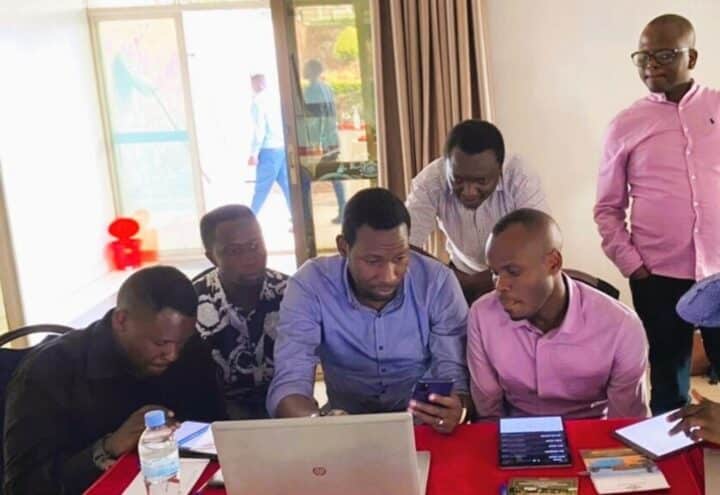
The RBC team worked through some challenges in the early phases. Where facilities faced unreliable internet access, officials worked with partners to improve connectivity and enabled offline data entry with periodic synchronization, so data capture would not stall in lower-connectivity areas. Digital literacy was also a barrier for some staff in the early years of the registry, but has improved as computer and smartphone use has become routine. Finally, data quality problems changed once the data entry moved from a small, fully trained central team out to facility staff with varying levels of skill. Hagenimana warns that transitioning to DHIS2 is not a reason to cut the registry team.
“If people are learning from us, they can say ‘now DHIS2 is coming, now we are done, we no longer need the staff.’ But cancer is multidisciplinary, and this requires advanced skills from different experts.” – Marc Hagenimana
The RBC keeps staff working full time on analyzing facility data and returning real-time feedback on data quality. Now, when a facility’s data shows problems, the central team responds with virtual mentorship or an in-person coaching visit.
And though the RBC has built a capable staff and has become less reliant on external support to maintain the registry, Hagenimana said it is important to always have the support of a local HISP partner. “HISP is always needed,” he said. “Because even if the registry is fully integrated into the MoH, you can face at any time a technical challenge,” ranging from server issues, to upgrades, to planned integrations such as automated data exchange with hospital electronic medical records.
A Reference for Cancer Registries Worldwide
International cancer-data bodies have taken notice of Rwanda’s experience. At the DHIS2 Annual Conference in Oslo in June 2026, the International Agency for Research on Cancer (IARC) described Rwanda’s DHIS2 Oncology Tracker as a reference implementation for countries seeking to modernize population-based cancer registries without building costly parallel systems.
Rwanda was the first country to run a national cancer registry in DHIS2, and other countries have followed. The RBC has hosted technical visits from Zimbabwe, Tanzania, and Mozambique, all in early stages of their own implementations, and has fielded inquiries from Nigeria and Ethiopia as well. Kenya has already begun its own DHIS2-based registry, launched in 2021, and Rwanda shared its experience with countries in the Caribbean, through a collaborative project with IARC.
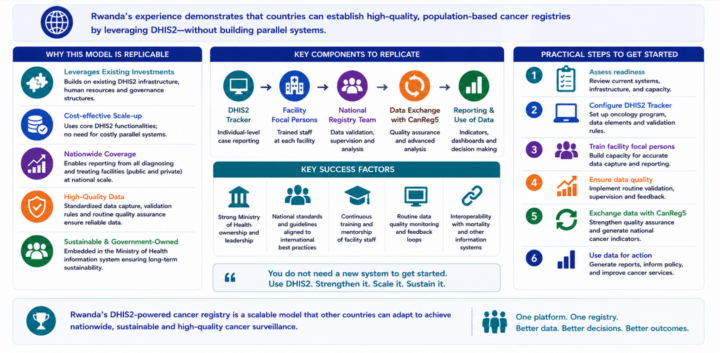
As word spread, the demand for information eventually outgrew what the national registry team could support. IARC worked with partners at Vital Strategies and the HISP Centre at the University of Oslo to build a global DHIS2 cancer registry toolkit that any ministry of health can adopt—without traveling to Kigali. It is built on Rwanda’s metadata, refined with improvements contributed by the countries that have since adopted it.
Rwanda Biomedical Centre officials say their model, which is built on the DHIS2 infrastructure that most health ministries already maintain, is intended to be replicable for other countries working to close the gap in cancer surveillance. “If I see now other countries starting to use it, I say, ‘oh wow, that is a very good achievement from our country.'”
In Rwanda, the RBC aims to continue its work with the DHIS2 Oncology Tracker, linking to additional systems and supporting new kinds of analysis in the future. Hagenimana said the centre plans to automate data exchange with electronic medical records, use oncology data for research and policy development, and to eventually support a DHIS2 oncology center of excellence.
“Together, we can create a global, open-source oncology ecosystem that improves cancer care, research, and public health decision-making worldwide.” – Marc Hagenimana