Laos PDR has a well-developed policy and governance environment for climate and health.
National policy
The Health National Adaptation Plan (H-NAP) of Lao PDR for 2025-2030 provides a comprehensive framework to build a climate-resilient health system, reducing vulnerability to climate impacts while increasing adaptation capacity in the health sector. It references the need for integration of climate data into DHIS2 to support analysis of a range of climate-related health impacts.
Governance & coordination
Memoranda of Understanding have been signed between Ministries of Health and Environment to facilitate climate-health data sharing and intergovernmental collaboration. Committees and technical working groups have been established to support the implementation of the country grant from the Green Climate Fund. The MoH has established structures such as the Public Health Emergency Operations Centre (PHEOC), an incident management system and weekly inter-sectoral emergency planning & readiness meetings at senior levels. SOPs have been drafted for responding to a number of notifiable infectious and epidemic-prone diseases and drafted for emerging climate-resilient health sector preparedness such as flash flood protocols. These SOPs and structures are being adapted for climate-related health threats.
Partner & funding landscape
Lao PDR has a strong partnership environment coordinated by the MOH and including technical support for climate health and HIS strengthening from the WHO country office, collaboration with implementing partners like CHAI and PSI to strengthen data use, and research partnerships such as with Institut Pasteur and the Wellcome-Oxford research unit based at Mahosot hospital. HISP Vietnam-Mekong, through its local Laos office, provides advanced technical support for DHIS2 systems in Lao PDR. Partnerships also reach beyond the health sector: the Mekong River Commission (MRC) provides the flood forecast data used for health sector early warning, and the UNICEF Lao PDR country office has funded the school-based air quality sensor network whose data is now integrated into DHIS2.
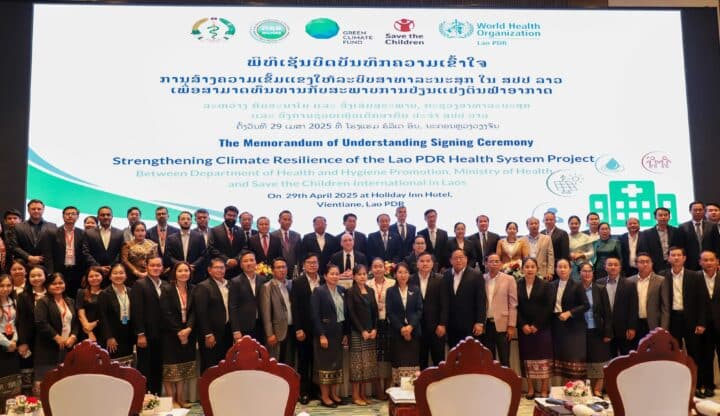
In addition to catalytic funding for climate and health systems from Wellcome through the HISP-led DHIS2 Climate & Health project, in 2025 Laos signed an MOU with Green Climate Fund prime recipient Save the Children Australia for implementing a health systems strengthening investment for climate resilience. Strong foundational components such as integrated health data systems, access to digitized climate data, and technical partnerships steered by government priorities with WHO are expected to accelerate progress in the country now that domestic resources have become available to operationalize key parts of the H-NAP in the coming years.