Go to the main page

Nepal: DHIS2 Climate & Health Country Profile

Nepal is leveraging local climate and health expertise to explore using climate data and predictive modeling capabilities in DHIS2 to support early warning of dengue outbreaks, as well as other national health priorities.

Jump to a section on this page

    DHIS2 for Climate & Health in Nepal

    Nepal was one of the 10 countries involved in the first phase of the DHIS2 Climate & Health project from 2024-2026. The work in Nepal has focused primarily on modeling and early warning of dengue outbreaks, as well as strengthening local DHIS2 systems and implementing new tools for data integration and predictive modeling. This work is led by Planetary Health Research Center (PHRC), Kathmandu in collaboration with the Ministry of Health and Population and Department of Hydrology and Meteorology with DHIS2 technical support from HISP India and engagement on climate-health action research from HISP UiO.

    Updated: July 2026

    Priority climate & health use cases

    Nepal’s Ministry of Health and Population has identified one primary initial focus area for piloting DHIS2 climate & health systems, along with other areas of potential interest.

    • Early warning system for climate-sensitive diseases (in testing) initially focused on dengue, with interest in expanding to other vector-borne diseases like malaria and Japanese encephalitis.
    • Nutrition & food security (concept in development)
    • Heat, health & air quality (concept in development)
    • Climate resilient health infrastructure & service delivery (concept in development)

    The burden of dengue is increasing as a public health problem in Nepal, with evidence pointing to changing climate factors in recent years that have affected the vector habitats and human susceptibility. While literature has addressed these challenges, stakeholders in Nepal are leveraging an action research approach to test interventions that will allow them to act on this data increasingly in real-time. The DHIS2 use case for dengue early warning is particularly relevant given Nepal’s challenges in the climate change-related expansion of geographic areas of dengue suitability that impact lowland, hill and highland settings distinctly.

    Information system infrastructure

    DHIS2 Climate & Health work in Nepal builds off of and strengthens existing DHIS2 infrastructure and capacity, while incorporating innovative DHIS2 tools for climate data integration and predictive modeling.

    Health information systems & capacity

    In Nepal, DHIS2 has been used as the country’s national-scale health management information system (HMIS) since 2016. Nepal is also used for routine disease surveillance of priority diseases, including dengue. Health stakeholders in Nepal have achieved significant impact using DHIS2 for specific programmes, such as HIV. However, the system has also faced some challenges due to fragmentation as well as infrastructure and capacity limitations. In the climate and health project, the PHRC has primarily been working in a test instance of DHIS2 that pulls disease data from Nepal’s HMIS, where they have developed various climate-health information products for dengue surveillance. Following successful testing of their predictive modeling approach, PHRC plans to discuss implementation of these solutions in the HMIS with the Department of Health Services.

    There is not currently an established local HISP group in Nepal. HISP India has provided DHIS2 technical assistance and capacity building support to the government of Nepal for several years, and has provided support as needed for the climate and health project in collaboration with the PHRC.

    Climate data integration

    The DHIS2 Climate App has been installed in the DHIS2 testing system, making ERA-5 reanalysis data and CHIRPS precipitation data available. Nepal partners have assessed these globally available re-analysis data sets as well as local datasets for use in climate-health programming. While Nepal has more than 40 years of rainfall and temperature from across the country (most of which is digitized), coverage is very low in mountain regions, and incomplete data continues to be a major concern for use of local data. Certain local geo-spatial datasets have already proven more useful in DHIS2 based on the higher resolution. The PHRC team continues to work on integrating these local data sets through DHIS2 Climate Tools, and is also planning to develop automated pipelines to ingest MODIS earth observation data and other non-climate data sets.

    The Nepal team is actively following the development pathway for Open Climate Services Nepal (OCS). As part of this process, OCS Nepal instances have been successfully installed and configured, and the team has initiated the ingestion of global datasets to support subsequent system development, testing, and service deployment.

    Predictive modeling

    Nepal’s work on predictive modeling with DHIS2 is guided by the goal of developing a robust dengue predictive model and operationalizing it within the DHIS2 ecosystem to strengthen dengue surveillance and early warning in Nepal. Key questions this work explores include which factors are most significant in driving dengue outbreaks in Nepal, which data sets and models can produce the best predictions, what are the best ways to integrate local weather data in the absence of gridded data products, and how to address the issue of low numbers of data points in certain geographical areas (such as highland areas where dengue cases have historically not been routinely reported).

    The PHRC team, with support from HISP India, has installed the Chap Modeling Platform and DHIS2 Modeling App on the DHIS2 climate testing instance. The WHO EWARS model has been successfully implemented and tested alongside other models, and several global data sets have been integrated to improve model performance, including ERA-5 Land, CHIRPS and MODIS. Next steps include integration of non-climate factors into the model and operationalization within DHIS2 in collaboration with stakeholders involved in disease surveillance and control programmes in the Government of Nepal.

    Policies, partnerships & governance

    Nepal has a well-developed policy landscape for climate and health, reflecting a decade of strategic planning.

    National policy

    Nepal has had a Health National Adaptation Plan (H-NAP) since 2017 and is currently implementing its updated H-NAP 2023-2030. The document identifies several national strategic objectives of climate change health adaptation strategies. Of particular relevance to DHIS2 is the country’s goal to manage the identification, prevention, control and treatment system of climate sensitive health risks including the development of a disease surveillance, preparedness and response system. Supporting policy documents have also called for strengthening climate-sensitive diseases surveillance systems through the integration of climate and weather data into existing surveillance systems.

    Governance & coordination

    Formal multi-sectoral coordination mechanisms exist for climate and health in Nepal, including multi-sectoral steering and technical committees formed at the Ministry of Health and Population. An MoU and data sharing agreement has been signed between the Department of Hydrology and Meteorology and Department of Health Services to facilitate climate-health data access.

    Strong multidisciplinary research collaboration has also been established, with demonstrated leadership from the Planetary Health Research Centre (PHRC). The PHRC, in collaboration with the Ministry of Health and Population and Nepal Health Research Council in Nepal, have joined research efforts with the Norwegian Institute of Public Health (NIPH) and the HISP Centre at University of Oslo.

    Partner & funding landscape

    Funding for initial work on DHIS2 climate and health systems in Nepal has primarily come from Wellcome through the HISP-led DHIS2 Climate & Health project. PHRC also received funding support from Norad for developing a case study on dengue and climate resilient health systems in Nepal. GIZ and the WHO country office both provide in-kind technical support for DHIS2. In addition, there are several other recent or ongoing projects that contain elements of strengthening Nepal’s systems and capacity for climate and health, including funding from the Directorate-General for Development Cooperation and Humanitarian Aid (Belgium), the Center for International Development (CID) and the Mittal Institute at Harvard University, Asia Pacific Observatory on Health Systems and Policies, and the Danish Red Cross.

    News & updates

    Learn more about DHIS2 Climate & Health work in Nepal:

    Conference Presentation: Dengue early warning in Nepal

    During a session at the 2026 DHIS2 Annual Conference, the PHRC team presented on the work in Nepal on predictive modeling and early warning of dengue outbreaks.

    Watch Recording

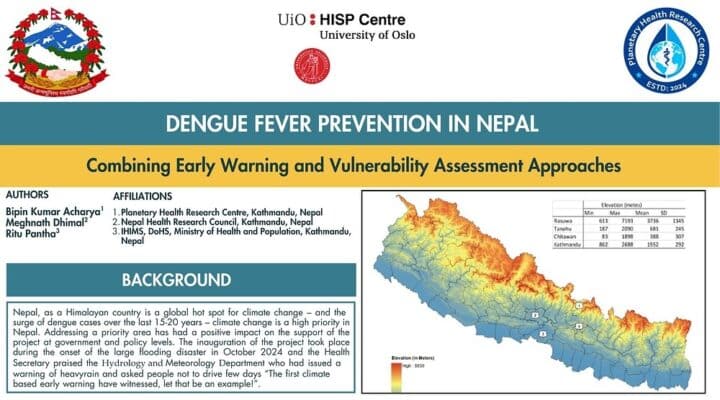
    Poster: Dengue Fever Prevention in Nepal: Combining Early Warning and Vulnerability Assessment Approaches

    The PHRC team presented a poster in June 2025 summarizing the country’s progress with DHIS2 for Climate & Health for dengue early warning.

    Learn More

    Contact

    Are you working on climate and health in Nepal? We would love to hear from you. Contact the global DHIS2 Climate & Health project team at climate@dhis2.org, or connect with the Planetary Health Research Center in Nepal at: bacharya@phrcnp.org / phrcnepal@phrcnp.org