Go to the main page

Rwanda: DHIS2 Climate & Health Country Profile

Rwanda is exploring integration of climate data and predictive modeling capabilities into existing DHIS2 systems to support national climate and health priorities, with an initial focus on malaria early warning.

Jump to a section on this page

    DHIS2 for Climate & Health in Rwanda

    Rwanda was one of the 10 countries involved in the first phase of the DHIS2 Climate & Health project from 2024-2026. Climate and health initiatives in Rwanda are coordinated between the Ministry of Health, the National Meteorology Agency, and other government agencies, and implemented through a national steering committee that includes HISP Rwanda, the Rwanda Biomedical Center, and other partners. The ongoing DHIS2 Climate & Health work in Rwanda has focused on integration of climate data into national DHIS2 systems and the development and testing of predictive models to support malaria early warning and response.

    Updated: July 2026

    Priority climate & health use cases

    The Rwandan Ministry of Health has identified malaria as an initial focus area for piloting DHIS2 climate & health systems:

    • Climate-informed malaria risk monitoring & early warning (piloting), focused on integrating climate data and historical malaria data to generate forecasts and outbreak threshold alerts to facilitate targeted interventions.

    Information system infrastructure

    DHIS2 Climate & Health work in Rwanda leverages existing DHIS2 infrastructure and capacity, while testing innovative DHIS2 tools for climate data integration and predictive modeling.

    Health information systems & capacity

    DHIS2 has been used as Rwanda’s national health management information system (HMIS) since 2012, containing routine data on all key public health programs. It now serves as the backbone of Rwanda’s national Health Intelligence Center. Rwanda has often served as a country of “firsts” for DHIS2 and digital health innovation in Africa: achieving a national scale electronic immunization registry, implementing advanced use cases for DHIS2 Tracker programs such as hypertension and cancer screening, establishing cross-sectoral data sharing with DHIS2, and scaling up facility electronic medical records (EMRs).

    The MoH has a core DHIS2 team supporting the HMIS as well as a number of complex DHIS2 individual-level systems at national scale. The MOH, alongside the Rwanda Biomedical Center (RBC), have demonstrated a strong capacity for using DHIS2 as an active disease surveillance, outbreak response and health emergency management system, including in response to recent outbreaks of Marburg and Ebola. HISP Rwanda provides DHIS2 technical assistance to the MoH, RBC, and other local partners.

    Climate data integration

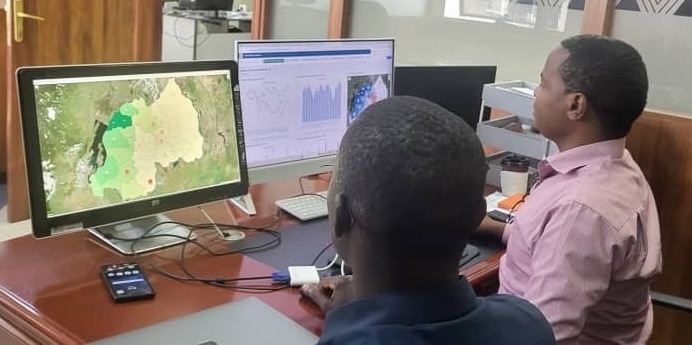
    The DHIS2 Climate App has been installed in Rwanda’s national HMIS system, enabling import and integration of climate data from the globally available ERA-5 Land and CHIRPS data sets. In addition, local climate and weather data from Rwanda’s ENACTS MapRoom has been integrated using the ENACTS Integrator, and HISP Rwanda worked with local stakeholders to digitize and integrate malaria intervention data from a number of sources using DHIS2 Climate Tools. This data has been used to create a prototype climate-malaria dashboard in DHIS2.

    Predictive modeling

    The Chap Modeling Platform and DHIS2 Modeling App have been installed on a DHIS2 testing instance in Rwanda. A predictive analytics workflow has been defined, testing has been completed on several globally available models, and local development and evaluation of predictive models is ongoing.

    There is strong capacity for modeling and advanced statistical analysis through MoH, RBC and partnerships with local universities. The MoH Director of Planning comes from a modeling background and has been actively engaged in contributing this expertise to testing models in DHIS2 and Chap for early warning systems of climate-sensitive diseases. The HISP Rwanda team has also onboarded a local modeler who works closely with the malaria program and the HMIS units on these solutions.

    Policies, partnerships & governance

    Rwanda has a policy landscape for climate and health that is supported by evolving governance structures.

    National policy

    Rwanda has a National Adaptation Plan (NAP), and is now working on a Climate Change and Health Vulnerability and Adaptation Assessment (V&A). An H-NAP is planned for development after the V&A is completed. One key priority climate-health area identified in the NAP is prevention of vector-borne diseases.

    Governance & coordination

    Formal mechanisms for climate and health coordination across the MoH, National Meteorology Agency (Meteo Rwanda), and other agencies have already been established, and cross-sector data sharing agreements, including between MOH and Meteo Rwanda for the use of climate services. A national climate-health steering committee has been established, with HISP Rwanda included as a member. HISP Rwanda has collaborated with the MoH on capacity building on DHIS2 for Climate & Health.

    Partner & funding landscape

    The government of Rwanda commits some of its own domestic resources to climate and health programming, such as through the National Council of Science and Technology. The country is also actively seeking additional funding touchpoints for DHIS2 Climate & Health, such as through Global Fund country grant mobilization.

    News & updates

    Learn more about DHIS2 Climate & Health work in Rwanda:

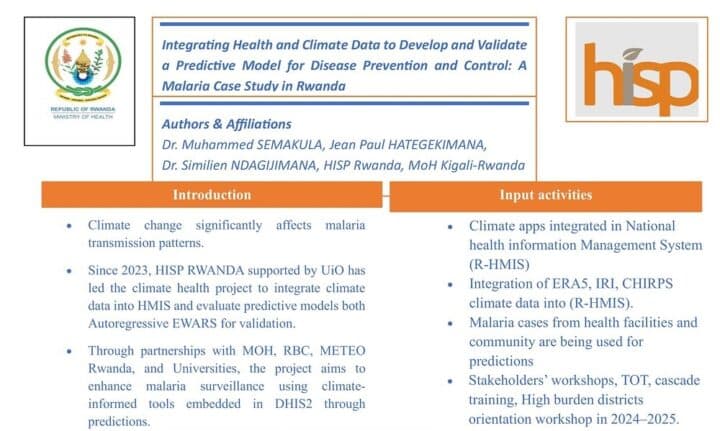
    Poster: Integrating Health and Climate Data to Develop and Validate a Predictive Model for Disease Prevention and Control: A Malaria Case Study in Rwanda

    HISP Rwanda presented a poster in June 2025 summarizing the country’s progress with DHIS2 for Climate & Health.

    Learn more

    Additional resources

    Explore these additional resources for more information:

    Contact

    Are you working on climate and health in Rwanda? We would love to hear from you. Contact the global DHIS2 Climate & Health project team at climate@dhis2.org, or connect with HISP Rwanda at: contact@hisprwanda.org