Go to the main page

Sri Lanka: DHIS2 Climate & Health Country Profile

Sri Lanka leverages existing DHIS2 health information system infrastructure and capacity and new tools for climate and environmental data integration and predictive modeling to support a multi-threat approach to climate-related health impacts.

Jump to a section on this page

    DHIS2 for Climate & Health in Sri Lanka

    Sri Lanka was one of the 10 countries involved in the first phase of the DHIS2 Climate & Health project from 2024-2026. This work is coordinated under the Ministry of Health, in collaboration with the Department of Meteorology, the University of Colombo, and other stakeholders, with technical assistance from HISP Sri Lanka. Priority areas include analyzing and forecasting the health impacts of heat and air pollution, and to enhance nutrition surveillance. This work builds on the established use of DHIS2 as a locally owned, national-scale system for health information management for maternal and child health and nutrition programmes.

    Updated: July 2026

    Priority climate & health use cases

    The Government of Sri Lanka demonstrates a multi-thread approach to leveraging DHIS2 Climate & Health tools, focusing on public health challenges that are influenced by environmental factors:

    • Air quality & health risk analysis and early warning (piloting) using PM2.5 data combined with morbidity and mortality data to analyze health risks from air pollution and develop an early warning system to drive preventative action.
    • Heat & maternal and child health (piloting) using air temperature and humidity data to produce district-level alerts for vulnerable populations to support preventive health care.
    • Predictive maternal and child health nutrition surveillance (piloting) to support early detection and reduce climate impacts through climate-informed district-level dashboards.
    • Early warning system for climate-sensitive diseases (in testing) initially focused on dengue, with interest in filaria, malaria & other notifiable diseases.
    • Climate-resilient health facility assessment & monitoring (concept in development) supporting health sector preparedness and response.
    • Extreme weather events & health impact (concept in development)

    Information system infrastructure

    DHIS2 Climate & Health work in Sri Lanka builds off existing DHIS2 infrastructure and capacity, while incorporating innovative DHIS2 tools for climate data integration and predictive modeling.

    Health information systems & capacity

    Sri Lanka has used DHIS2 at national scale since 2014. Instead of a centralized aggregate HMIS database, the country uses DHIS2 as an electronic registry and a management information system for prioritized health programs, such as reproductive, maternal, neonatal, child & adolescent health (RMNCAH) and nutrition, which contain community-based data from across the country. Sri Lanka also uses DHIS2 for monitoring and campaign planning of specific climate-sensitive infectious diseases such as Malaria. In addition, the country’s hospitals and health facilities collect ICD-10 coded inpatient morbidity and mortality data through electronic medical records (EMRs), which are aggregated in the national eIMMR system and pushed to the national DHIS2 climate and health platform where it is combined with climate data for analysis. Advanced technical support and capacity building for national DHIS2 systems is provided to the Ministry by HISP Sri Lanka.

    Climate data integration

    The DHIS2 Climate App has been installed on Sri Lanka’s national DHIS2 environment, as well as in the DHIS2 systems for the RMNCAH and Nutrition programmes, and is being used to import temperature, rainfall, and heat stress index data from globally available data sets such as ERA-5 Land and CHIRPS, as well as the Enhanced Vegetation Index (EVI) for land cover data. Local air quality data and population data are available through the National Building Research Organisation (NBRO) and are integrated using DHIS2 Climate Tools, with support for bias correction and modeling from CICERO.

    Predictive modeling

    The Chap Modeling Platform and DHIS2 Modeling App have been installed in national DHIS2 RMNCAH and nutrition systems to support climate and health use cases. Ministry of Health teams are collaborating with HISP Sri Lanka to test and validate model performance on key indicators, such as the relationship between heat stress and neonatal mortality, stillbirth rates, and incidence of underweight infants.

    Policies, partnerships & governance

    Sri Lanka has a well-developed policy and governance environment for climate and health.

    National policy

    The National Adaptation Plan (NAP) of Sri Lanka for 2016-2025 provides an overview of priority areas of concern related to the impacts of climate change and health, including changes to climate-sensitive disease spread and outbreak patterns, heat and thermal stress, and impacts on health from extreme weather or other hazardous events. It also outlines several priority health actions that are tied to the country’s information systems, including establishing a surveillance programme for detection and monitoring of climate-induced diseases, conducting analyses of climate-related health impacts, and strengthening data-sharing mechanisms.

    Governance & coordination

    Climate & Health work in Sri Lanka is coordinated by the Ministry of Health. The MoH has a data sharing arrangement with the Department of Meteorology and National Building Research Organisation (NBRO) which provides local heat and air quality data. CICERO has been engaged to provide subject matter expertise on air quality and heat modeling. HISP Sri Lanka collaborates across these partners and provides DHIS2 support for Sri Lanka’s climate and health initiatives.

    Partner & funding landscape

    Initial funding for DHIS2 Climate & Health work in Sri Lanka has been provided through the Wellcome-funded project led by HISP UiO. The Ministry of Health provides in-kind support by assigning health informatics resources from the Health Information Unit and other departments engaged with the Climate Health pilot work. The Ministry of Health is actively investigating other potential partnerships and sources of funding, while HISP Sri Lanka is pursuing support through research partnerships with the University of Washington, University of Colombo, and CICERO.

    News & updates

    Learn more about DHIS2 Climate & Health work in Sri Lanka:

    Conference Presentation: Air Quality, Heat & Health in Sri Lanka

    During a session at the 2026 DHIS2 Annual Conference, HISP Sri Lanka presented on the work in Sri Lanka on analyzing the health impacts of heat and air quality.

    Watch Recording

    Conference Presentation: Integrating Climate Intelligence into DHIS2 for Predictive MCH Surveillance

    In this session from the 2026 DHIS2 Annual Conference, HISP Sri Lanka shared their work on nutrition early warning for maternal and child health in Sri Lanka.

    Watch Recording

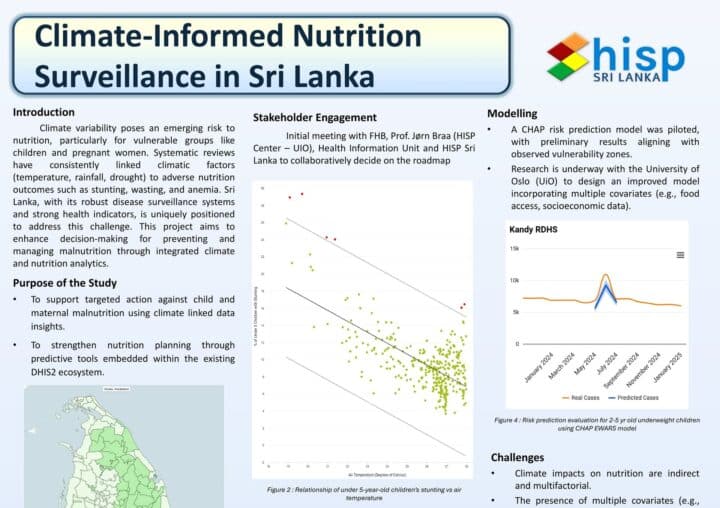
    Poster: Climate-Informed Nutrition Surveillance in Sri Lanka

    HISP Sri Lanka presented a poster in June 2025 summarizing the country’s progress with DHIS2 for Climate & Health for nutrition surveillance.

    Learn More

    Additional resources

    Explore these additional resources for more information:

    Contact

    Are you working on climate and health in Sri Lanka? We would love to hear from you. Contact the global DHIS2 Climate & Health project team at climate@dhis2.org, or connect with HISP Sri Lanka at: contact@hispsrilanka.org