Go to the main page

Malawi: DHIS2 Climate & Health Country Profile

Malawi is building on more than a decade of work on climate and health by enhancing data harmonization, integrating new DHIS2 predictive modeling capabilities with EWARS to support early warning for malaria and other climate-sensitive diseases, and developing innovative tools to help drive informed action from national to community levels.

Jump to a section on this page

    DHIS2 for Climate & Health in Malawi

    Malawi was one of the 10 countries involved in the first phase of the DHIS2 Climate & Health project from 2024-2026. This work built on earlier national pilots for malaria early warning led by the WHO country office, local climate data digitization work through the ENACTS initiative, and the established use of DHIS2 as a locally owned, national-scale system for health information, disease surveillance, and agriculture program management. Malawi continues to develop DHIS2 climate and health systems under the leadership of the Ministry of Health with support from funding and implementation partners, including HISP University of Malawi (UNIMA).

    Updated: July 2026

    Priority climate & health use cases

    Malawi’s Ministry of Health has identified several initial focus areas for piloting DHIS2 climate & health systems:

    • Forecasting & early warning for climate-sensitive diseases (in testing) initially focused on malaria, with interest in diarrheal disease, cholera & other emerging priorities.
    • Malnutrition surveillance (in testing) through integration of nutrition, agriculture, and climate data.
    • Heat health & air quality (concept in development)

    Information system infrastructure

    DHIS2 Climate & Health work in Malawi builds off existing DHIS2 infrastructure and capacity, facilitates interoperability with complementary systems, and incorporates innovative DHIS2 tools for climate data integration, predictive modeling, and dissemination of tailored outputs to key actors from national to community levels.

    Health information systems & capacity

    In Malawi, DHIS2 has been used by the Ministry of Health since 2012 (when it replaced the original DHIS system) as their Health Management Information System (HMIS), their main data collection and aggregation tool and national repository for health data, covering more than 60 health programs. Malawi also uses DHIS2 for routine disease surveillance, for community health programs through the iCHIS system, and as a One Health Surveillance Platform (OHSP). The Ministry of Agriculture uses DHIS2 for the National Agricultural Management Information System (NAMIS), which includes local weather data and data on agricultural production. These systems are owned and maintained by the MoH and MoA, with technical support from HISP UNIMA.

    Through the DHIS2 Climate & Health project, HISP UNIMA has worked on several enhancements to Malawi’s DHIS2 systems:

    • Sub-district-level data gridding for facility- and community-level catchment areas, using population data from WorldPop and custom data processing through DHIS2 Climate Tools to generate a more accurate representation of geographical location of malaria cases.
    • Climate-informed surveillance products (Climate Bulletin) through a custom app in DHIS2, bringing together various data outputs for malaria, cholera, and other climate-sensitive diseases–including outbreak forecasts, recorded cases, health advisories, and weather forecasts–into an automatically generated report available as a dynamic dashboard and PDF for dissemination to district health managers and national staff.
    • Climate- and AI-informed tasking for community health workers using a customized chat-bot interface through the iCHIS that provides guidance on potential actions to respond to climate-sensitive health risks.

    Some key challenges that have been identified are the multiplicity of DHIS2 instances, which complicate solution deployment and threaten data integrity, and some gaps in the availability of weekly data for malaria.

    Planned future enhancements and next steps include addressing temporal resolution discrepancies to create a “single source of truth” for surveillance data, and deploying the Analytics Platform to integrate data from various DHIS2 instances–and other systems such as EWARS–and enhance visualization capabilities.

    Climate data integration

    The DHIS2 Climate App has been installed in the national HMIS and iCHIS systems, and is undergoing testing and validation with local stakeholders, including with the WHO country office for key EWARS components. HISP UNIMA has worked with the IRI team to develop the ENACTS Data Sharing Tool (DST), which allows integration of local weather and climate data from Malawi’s ENACTS MapRoom into DHIS2. HISP UNIMA has also developed data harmonization engines for disease surveillance data that have been implemented through DHIS2 Climate Tools.

    Next steps include operationalizing the Climate App across all national DHIS2 instances, and finalizing the disaggregation and harmonization of climate and environmental data from district-level to fine-scale community/village level data.

    Predictive modeling

    HISP UNIMA has installed the Chap Modeling Platform and DHIS2 Modeling App on a DHIS2 testing instance and has tested the modeling framework for malaria case prediction with the National Malaria Control Programme. A series of models have already been developed and tested for accuracy and utility. HISP UNIMA has also Initiated EWARS-csd model testing via the DHIS2 Modeling App in collaboration with the WHO country office, and is working to develop a hybrid Chap-EWARS solution.

    Policies, partnerships & governance

    Malawi has a well-developed policy landscape for climate and health, reflecting more than a decade of strategic planning.

    National policy

    Malawi’s initial climate change and health program was established in January 2014. This initiative helped to build local capacity and informed policy development, including the country’s Health National Adaptation Plan (H-NAP). A Vulnerability and Adaptation (V&A) assessment has also been conducted to assess which populations and districts are most vulnerable to climate-related health impacts.

    Governance & coordination

    The Ministry of Health is responsible for ensuring health system resilience and adaptive capacity for climate-health risks. The National Malaria Control Programme is responsible for national malaria initiatives and data systems. The WHO country office has provided technical and capacity-building support, particularly in the areas of climate & health and predicting and responding to vector-borne disease outbreaks through using the EWARS approach. The Department of Climate Change and Meteorological Services is responsible for Malawi’s weather and climate data, including the ENACTS platform. HISP UNIMA coordinates DHIS2 Climate & Health work across these stakeholders.

    Partner & funding landscape

    The WHO has supported climate and health work in Malawi since 2014. Recent enhancements to DHIS2 systems and development of local innovations were financially supported through the DHIS2 Climate & Health project, funded by the Wellcome Trust, and through a two-year project (2025-2027) through the Global Program for Pandemic Resilience, One Health (PPOH), with funding from GIZ. A Green Climate Fund grant, implemented by Save the Children, also includes components to strengthen DHIS2 climate and health systems. HISP UNIMA is also collaborating with the Malawi-Liverpool-Wellcome Research Program on several climate and health projects, and supporting local research projects through the University of Malawi.

    News & updates

    Learn more about DHIS2 Climate & Health work in Malawi:

    Conference Presentation: Climate & Malnutrition in Malawi

    During a session at the 2026 DHIS2 Annual Conference, HISP UNIMA presented on their work on climate-informed malnutrition early warning in Malawi.

    Watch Recording

    News: Malawi Launches Project to Strengthen Surveillance of Climate-Sensitive Diseases with DHIS2

    The Ministry of Health, with support from GIZ and HISP UNIMA, will integrate climate and health data in the national HMIS and One Health Surveillance Platforms to enable early warning and response.

    Read More

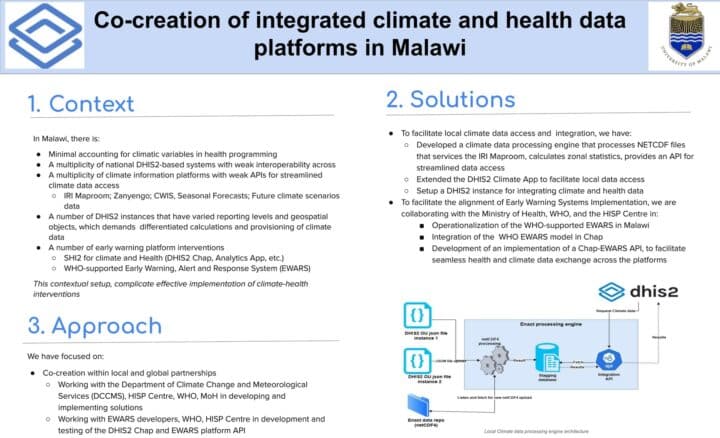
    Poster: Co-creation of integrated climate and health data platforms in Malawi

    HISP UNIMA presented a poster in June 2025 summarizing the work in Malawi on integrated platforms for climate and health.

    Learn More

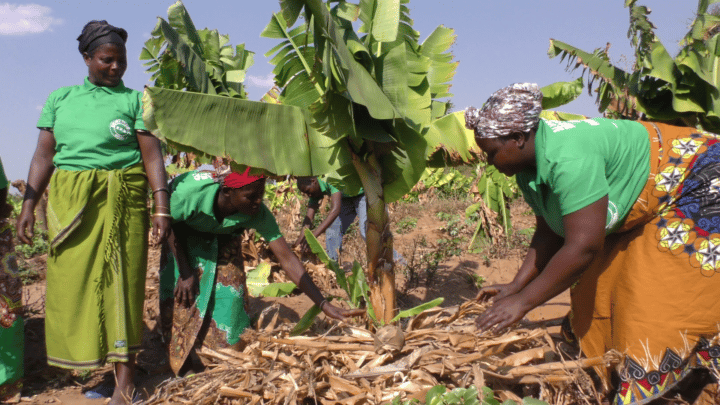
    Lead farmers monitor crop development at a plantation in rural Malawi.

    Impact Story: Malawi supports small-scale agriculture and promotes food security using climate data in DHIS2

    A comprehensive, nationwide DHIS2-based management information system for agriculture harmonizes climate, demographic and agricultural data to improve food security in Malawi by supporting over 150,000 households.

    Read More

    Additional resources

    Explore these additional resources for more information:

    • Resources to come.

    Contact

    Are you working on climate and health in Malawi? We would love to hear from you. Contact the global DHIS2 Climate & Health project team at climate@dhis2.org, or connect with HISP UNIMA at: tmanda@unima.ac.mw