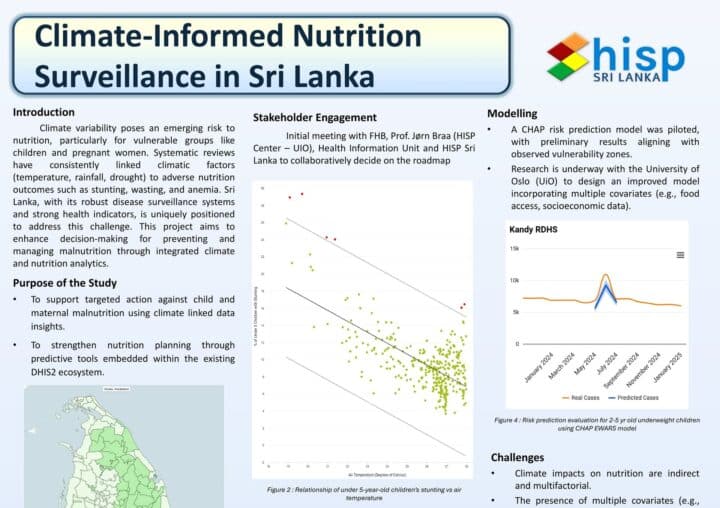
DHIS2 Climate & Health work in Sri Lanka builds off existing DHIS2 infrastructure and capacity, while incorporating innovative DHIS2 tools for climate data integration and predictive modeling.
Health information systems & capacity
Sri Lanka has used DHIS2 at national scale since 2014. Instead of a centralized aggregate HMIS database, the country uses DHIS2 as an electronic registry and a management information system for prioritized health programs, such as reproductive, maternal, neonatal, child & adolescent health (RMNCAH) and nutrition, which contain community-based data from across the country. Sri Lanka also uses DHIS2 for monitoring and campaign planning of specific climate-sensitive infectious diseases such as Malaria. In addition, the country’s hospitals and health facilities collect ICD-10 coded inpatient morbidity and mortality data through electronic medical records (EMRs), which are aggregated in the national eIMMR system and pushed to the national DHIS2 climate and health platform where it is combined with climate data for analysis. Advanced technical support and capacity building for national DHIS2 systems is provided to the Ministry by HISP Sri Lanka.
Climate data integration
The DHIS2 Climate App has been installed on Sri Lanka’s national DHIS2 environment, as well as in the DHIS2 systems for the RMNCAH and Nutrition programmes, and is being used to import temperature, rainfall, and heat stress index data from globally available data sets such as ERA-5 Land and CHIRPS, as well as the Enhanced Vegetation Index (EVI) for land cover data. Local air quality data and population data are available through the National Building Research Organisation (NBRO) and are integrated using DHIS2 Climate Tools, with support for bias correction and modeling from CICERO.
Predictive modeling
The Chap Modeling Platform and DHIS2 Modeling App have been installed in national DHIS2 RMNCAH and nutrition systems to support climate and health use cases. Ministry of Health teams are collaborating with HISP Sri Lanka to test and validate model performance on key indicators, such as the relationship between heat stress and neonatal mortality, stillbirth rates, and incidence of underweight infants.