
Eliminating Human Rabies Deaths in Namibia Through Targeted Dog Vaccinations with DHIS2
Namibia’s Directorate of Veterinary Services has recorded more than 130,000 dog vaccinations in a single year using DHIS2-based tools, supporting a national program that has cut human rabies deaths from 23 in 2015 to zero so far in 2026.
Dog-mediated rabies is endemic across northern Namibia, where an estimated 258,000 dogs live, most of them free-roaming. No rabies program in the region has ever had the funding to vaccinate all of them. When Namibia scaled up mass vaccination in the Northern Communal Areas in 2018, its paper records produced impressive-looking national totals but little indication of which communities the vaccine had actually reached, or where the virus was still circulating.
Since 2019, the Directorate of Veterinary Services has recorded every individual vaccination, education event, and confirmed animal rabies case using a set of DHIS2 tools developed by GARC, Rabies Alliance. Teams logged 130,538 dog and 11,120 cat vaccinations in 2025 and a further 73,810 dogs in the first six months of 2026, working across all eight regions of the Northern Communal Areas.
Because each record captured in DHIS2 carries a location and a date, the directorate can ring confirmed cases with targeted vaccination and concentrate campaigns where coverage has fallen behind, rather than spreading doses evenly across the region. As a result, human rabies deaths have fallen from 23 in 2015 to two in 2025, with none reported in the first half of 2026, and confirmed animal cases have declined in parallel, indicating that this program has achieved significant success.
Replacing paper forms with mobile data capture across eight regions
Namibia launched its national rabies elimination strategy in 2015 and intensified mass dog vaccination the following year, moving from paper forms to mobile data capture in 2019.
Most vaccination takes place during targeted mass campaigns in high-risk areas over the June and July school holidays, supplemented by routine vaccination at veterinary centers and by teams working alongside the annual cattle vaccination campaigns, which reach remote communities. The government funds roughly 70 percent of the program, with additional support from the World Organisation for Animal Health through a project financed by the German Federal Ministry for Economic Cooperation and Development.
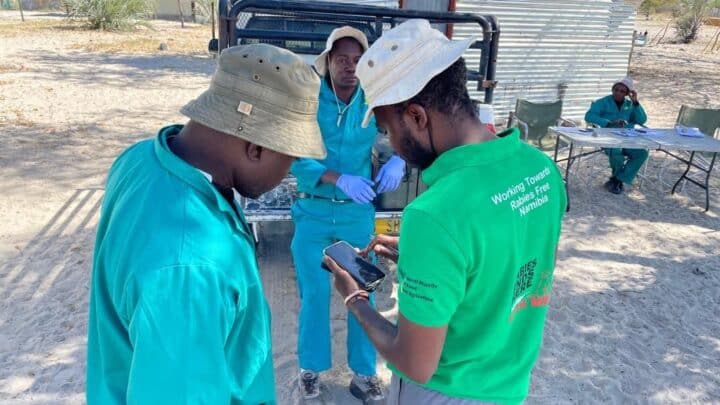
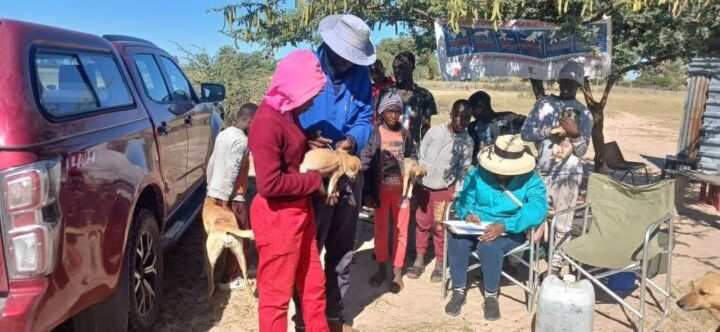
Between January and December 2025, teams vaccinated 130,538 dogs and 11,120 cats from more than 2,000 vaccination points. In the first half of 2026, 94 teams made up of 283 veterinary staff and temporary workers covered 2,945 vaccination points over roughly 30 days, vaccinating 73,810 dogs and 9,209 cats. The targeted school-holiday campaign reached 64,296 dogs, more than 8,000 above the equivalent 2025 figure. In Kavango East, teams vaccinated 5,826 dogs using oral rabies vaccine baits, a method Namibia is introducing alongside injectable vaccination.
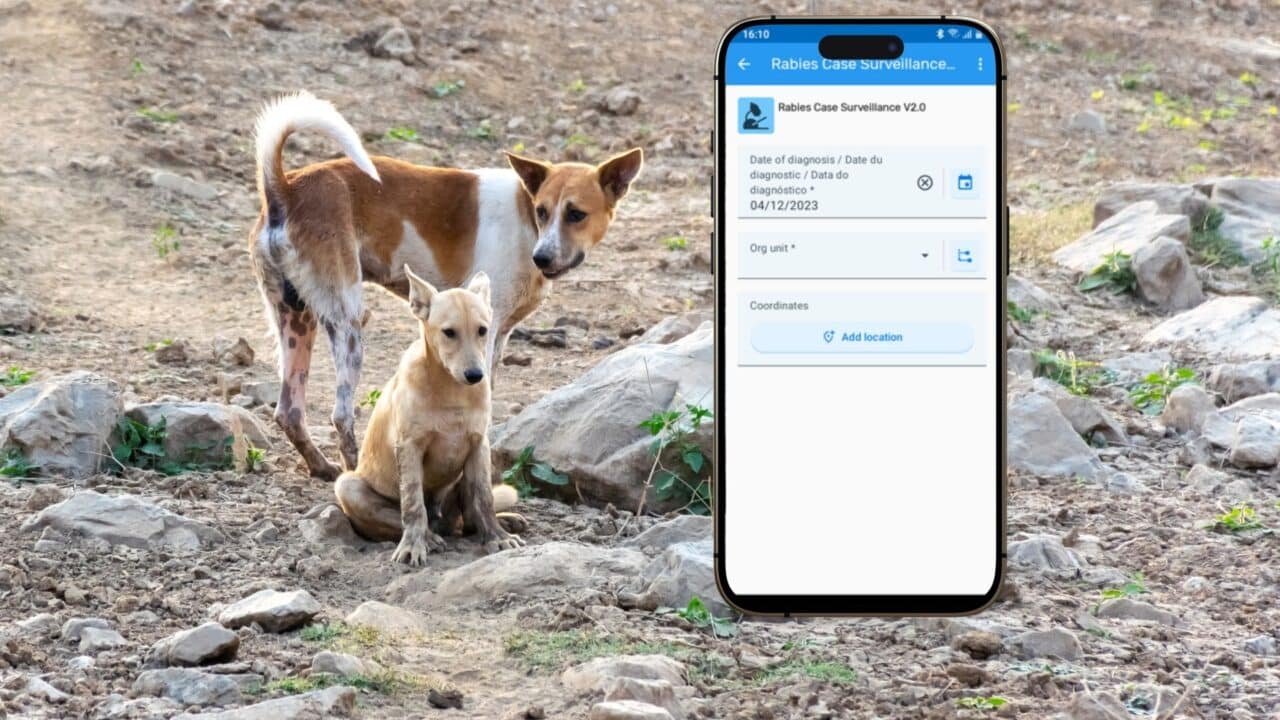
Teams record each animal on a smartphone, a process designed to take about 10 seconds so that data entry does not slow the queue at a vaccination point. These forms are configured in DHIS2 as event programs, meaning that each entry creates a unique DHIS2 record tied to that specific animal vaccination. These records contain granular information that would not be practical to capture or collate using paper records, and are uploaded to the central DHIS2 database in near real time.
“Since we started using the GARC Data Platform for our rabies elimination activities, we have noted a big improvement in the coordination of our rabies vaccination campaigns.” – Dr. Reinhold Haimbodi, Namibia’s national rabies project coordinator
Directing a limited vaccine supply toward the communities where rabies is circulating
Even with external support, Namibia has never had enough rabies vaccines to reach every dog. The Northern Communal Areas alone hold an estimated 258,000 dogs, most of them free-roaming, and achieving full vaccine coverage there has never been the operating model. Rather than attempting to reach every animal, officials must ask: Which animals do we need to reach first?
Data helps to answer that question. Because each vaccination and each confirmed case carries a location and a date, the directorate can draw a buffer around a case and vaccinate the animals within it, putting a ring of immunity around active transmission rather than spreading the same doses evenly across regions where the virus may not be circulating.
“It’s making their vaccine go a lot further, because they’re now going to where the rabies cases are before moving on to the surrounding communities,” said GARC Chief Executive Officer Dr. Andre Coetzer. GARC developed the DHIS2-based rabies data collection tools enabling data-driven decisions of that kind, he said. Because coverage can also be analyzed by region and constituency, the directorate can see where previous campaigns fell short, and plan future efforts accordingly.
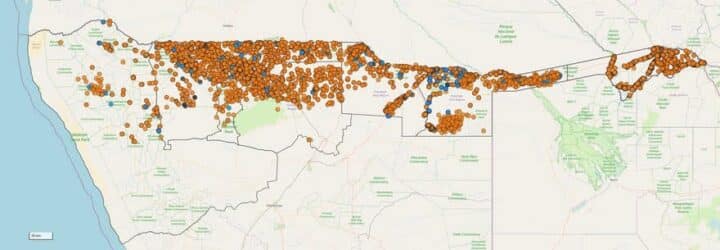
Dr. Reinhold Haimbodi, the national rabies project coordinator for the Directorate of Veterinary Services, has explained how the system lets his team monitor campaign progress remotely, watching each vaccination point appear on a map, and produce coverage analysis by region, by constituency and across the whole target area.
“With the GARC Data Platform, we are able to track the progress of the rabies vaccination campaign each and every day after the vaccinating teams upload the data on the platform,” he said. “Furthermore, our rabies vaccination data is now automatically analyzed, showing us the vaccination coverage achieved at the constituency, region, and national level, generating thematic maps, and this has been very instrumental in helping us see which constituency is lagging in terms of achieving recommended vaccination coverage.”
Additionally, the directorate tracks its education and outreach work in the same system, which enables it to estimate the reach of its awareness campaigns. In the first half of 2026, more than 12,000 children and 10,700 adults received rabies prevention education, with school-aged children playing a direct role in bringing dogs to vaccination points.
Suppressing rabies transmission below the coverage threshold
Human deaths from rabies in Namibia fell from 23 in 2015 to two in 2025, with none yet reported through the middle of 2026, and animal cases have declined in parallel. Of 35 samples tested from domestic animals and wildlife in the Northern Communal Areas, seven were confirmed positive, including two of 13 dogs tested.
Namibia has achieved these results despite its immunization program never reaching the 70 percent coverage of the total dog population benchmark for interrupting rabies transmission through vaccination alone. In fact, coverage was only 51 percent in 2025 and 28.6 percent through June 2026, with planned vaccinations continuing through the rest of the year. The directorate’s approach is not to pursue uniform coverage across all eight regions, but to concentrate vaccinations in areas where surveillance shows the virus is circulating, thus ensuring sufficient vaccination coverage of the at-risk communities. This approach has kept transmission low, even with a vaccine supply that would not stretch to cover a wider campaign.
Of course, data is one factor contributing to the reduction of human deaths, alongside sustained government funding, community engagement, and the introduction of oral vaccination. “It’s not necessarily just the data,” Coetzer said. “There’s an element of manpower and doing the work.”
What the data has certainly changed, however, is the program’s ability to demonstrate results. Namibia now publishes annual updates with maps, graphs and campaign distribution figures, where previously it could report little more than a count of dogs vaccinated. “The GARC Data Platform is helping us to do an informed rabies vaccination campaign, and it makes it easy to report to our development partner and enhance the transparency on the progress of the vaccination campaign,” Haimbodi said.
Haimbodi presented the country’s experience at an April 2026 workshop convened by the World Organisation for Animal Health with GARC and other partners, sharing how the government has collected and used vaccine data in its rabies program. Veterinary services in Hwange District, Zimbabwe, adopted the same vaccination tracking tool for a campaign the following month.
Specialized rabies tools on an open-source platform that governments control
The event programs that Namibia uses come from GARC, a nonprofit that supports communities to lead and sustain their dog-transmitted rabies elimination programs around the world. Those tools run on the GARC Data Platform, a DHIS2 instance the organization built and maintains itself. More than 80 organizations across 33 countries use it, from international bodies such as Veterinarians Without Borders to local animal welfare groups running spay and neuter campaigns, with users in Europe and Latin America, as well as Africa and Asia. Fourteen governments use it at subnational or national level. In Namibia, some nongovernmental partners also using the GARC Data Platform to record data have agreed that their data can feed into the same data set as the directorate’s own, which is how officials assemble a picture of areas government teams cannot reach.
GARC began looking for a data solution in 2015, after consultations with sub-Saharan African governments identified a shared gap in rabies burden data. A colleague who had worked on the Ebola response in Liberia recommended DHIS2, which was already widely deployed across health ministries. The first version of the GARC system, built in 2016, aligned with six-month and annual reporting indicators from the World Health Organization and the World Organisation for Animal Health. National governments shared data willingly, but the team concluded the approach was producing a distorted picture.
“Rabies is a disease where the burden is at the community level, and what we were capturing was national-level data,” Coetzer said. “It was a serious underestimate of what’s actually happening. We wanted the data to accurately reflect community realities.”
GARC then shifted to event-based data capture at the community level. The tools now cover vaccination, sterilization, oral vaccination, coverage estimation, case surveillance, bite cases, animal quarantine, treatment and education, and can be used alone or combined. They are offered at no cost to the end user, work offline on Android mobile devices, and let countries record the minimum data elements for rabies defined by the United Against Rabies Forum without redesigning their national health information systems.
All of this rests on the open-source DHIS2 software. GARC built its own configuration rather than commissioning software that would require maintenance by a vendor, with Coetzer and a colleague starting from an empty server and writing the event programs, indicators and organization unit hierarchies themselves, using knowledge they had acquired through a DHIS2 Academy course in Victoria Falls, Zimbabwe. There are no limits on accounts or scale, and a government that wants to run them on its own infrastructure can do so, with GARC providing technical support to rebuild the programs on a national instance if desired.
Namibia’s data sits on a cloud server that GARC hosts—the first of three options GARC offers, alongside connecting a national instance through an interface, or moving the programs onto the government system outright. With all of these options, countries maintain ownership and control of their own data. “We are just the custodians of the server. They are the owners of their data,” Coetzer said.
Namibia’s national system does not capture rabies data at the same level of detail, so rather than integrate the two systems directly, the directorate transfers a single high-level indicator, such as total dogs vaccinated in the calendar year, from the GARC platform into its national health information. This approach has been effective for Namibia, and has resulted in a system that the country manages on its own. The directorate creates its own user training materials, brings on new staff in house, and contacts GARC as needed to request new user accounts.
Extending DHIS2 into animal health and One Health surveillance
What Namibia’s animal health authorities are doing with rabies data is part of a wider shift. Ministries of agriculture and livestock in a growing number of countries are adopting DHIS2 for One Health and animal health surveillance, often on the same platforms their health ministries already run.
The reasoning is both epidemiological and practical. An estimated 60 percent of emerging infectious diseases originate in animals, which makes veterinary surveillance central to detecting outbreaks early. And because health ministries in more than 45 countries already use DHIS2, extending it into the veterinary sector lets governments build on infrastructure and technical capacity they already have, rather than procuring something new.
The DHIS2 Animal Health toolkit, developed in collaboration with the U.S. Centers for Disease Control and Prevention, is designed for ministries of agriculture and livestock, and can run on its own, or alongside public health surveillance in an existing system. In Zanzibar, veterinarians and community members report unusual events on a mobile device for verification at higher levels. Indonesia’s Ministry of Health runs a national One Health platform on DHIS2, and Burkina Faso operates a shared instance that integrates data across its health, livestock and environment ministries.
This work is supported by the HISP network, a group of locally registered nonprofit groups coordinated by the HISP Centre at the University of Oslo, working with partners in more than 80 countries. As a digital public good, DHIS2 can be adopted, adapted and hosted by the institutions that use it, which is how an organization like GARC can build specialized tools on the platform, and a government like Namibia keeps control of what it collects. The network also collaborates with the One Health quadripartite agencies, including WHO, the Food and Agriculture Organization and the World Organisation for Animal Health, on tools and standards that allow country-level data to feed into global early warning and reporting systems.